Showing posts with label Obamacare. Show all posts

Saturday, December 22, 2018

GOP removal of Mandate/Fines made no difference in ACA signups, undercutting ruling ACA unconstitutional!!!

Universal Health Care or Medicare for All is the money saving solution to our hugely complicated and expensive for-profit U.S. model. 

Let's hope the new Democratic House majority won't run away from the growing popularity for universal health, even though we've already seen them take a few steps backward. The time is now, and almost everyone can see that.

Unconstitutional? Surprise, Nope: The numbers are in for the 2019 ACA signup, and guess what, not having a "penalty" for skipping insurance didn't collapse the ACA after all. Note: Also keep in mind the signup period was shortened and advertising disappeared:
ModernHealthCare (subscription):Even though the Republican-led Congress repealed fines for being uninsured effective Jan. 1 ... The drop — from 8.8 million to 8.5 million — was far less than experts forecast.

The numbers are likely to change policymakers' understanding of how the law actually works. It could also undercut a Texas federal court case in which a Republican-appointed judge, U.S. District Judge Reed O'Connor recently declared the Affordable Care Act unconstitutional since the fines no longer exist ... With the fines gone, the coverage requirement can no longer be considered constitutional, he reasoned ... because it can't be separated from the coverage requirement.

But steady sign-up numbers are factual evidence that in the real world the coverage mandate doesn't drive the health care law. "The argument that it's somehow inseparable from protections for pre-existing conditions is a lot weaker," Levitt said.

Thursday, August 24, 2017

Every County in U.S. now covered by Insurers in the ObamaCare Marketplaces.

ObamaCare is collapsing? That must be true if Paul Ryan, Scott Walker and Donald Trump say unequivocally that it's collapsing and putting people in danger.


Republicans have once again proven they have no real concept of what an actual free market does. 

Way back when, I grew up with the popular talking point that there was always somebody behind you waiting to take your place if you decide to give up or fail. I think it's time to bring that back:
As of Thursday, every county in the U.S. will have at least one ObamaCare insurer in 2018.
CareSource announced that it would fill the last remaining "bare" county in Paulding County in Ohio. “The Marketplace provides vital health care coverage to more than 10.3 million Americans and we want to be a resource for consumers left without options," CareSource CEO and President Pamela Morris said in a statement. "Our decision to offer coverage in the bare counties speaks to our mission and commitment to the Marketplace and serving those who are in need of health care coverage.”

Menominee County in Wisconsin was slated to have no insurers on the exchanges next year until Security Health Plan announced Tuesday it would sell plans there in 2018.
With these announcements, there are no more bare counties in the U.S. for next year. About 80 counties at one point or another during the summer were at risk of having no ObamaCare insurers in 2018. Insurers are still waiting for certainty on key ObamaCare insurer payments called cost-sharing reduction subsidies.

Sunday, June 11, 2017

Walker stealing Trump's bizarre irrational Tweet lies to attack ACA.

It was pathetic and funny in a bizarre way when Paul Ryan bragged about the CBO prediction that people would see lower premiums in 2026, all the while telling us how wrong they're predictions have been in the past. Ryan's loyal low information voters nodded yes anyway.

That same weird double speak flowed out of Scott Walker's twitter trolling this week. Except this time someone called him out on it. Check out Charles Gaba gofundme site and his official information page, ACASignups.net:


I liked this tweeted response GIF:


After 50+ attempts to repeal the ACA, a CBO score that predicted 24 million losing coverage, and administrative rules hanging in the balance under Trump, is it so hard to imagine insurers not just leaving the marketplaces but the entire individual market as well. This is a self fulfilling prophesy for Republicans, who finally utilized that ridiculous "market uncertainty" excuse to kill ObamaCare, for real. 

Friday, April 21, 2017

New GOP Health Care con keeps ACA benefits, then grants Waivers to ACA benefits!

Here's my theory; Republicans want to keep the ACA framework in place so they can keep blaming "ObamaCare" for the failure of their meddling "revisions."

What else could explain the "new and improved" revised TrumpCare plan. Try not to laugh at how transparently ridiculous it is: Keep all the provision of Obamacare, but grant waivers to all the ObamaCare provisions!!! Nuts right?
The MacArthur Amendment would:• Reinstate Essential Health Benefits as the federal standard• Maintain the following provisions of the AHCA: Prohibition on denying coverage due to preexisting medical conditions. Prohibition on discrimination based on gender. Guaranteed issue of coverage to all applicants. Guaranteed renewability of coverage. Coverage of dependents on parents' plan up to age 26. Community Rating Rules, except for limited waivers.
Here are waivers that basically repeals ObamaCare, state by state:
The amendment would create an option for states to obtain Limited Waivers from certain federal standards, in the interest of lowering premium costs and expanding the number of insured persons.
Spelled out, "Maintaining the following provisions of the AHCA" which maintain some of the provisions of the ACA, means choosing not to maintain the provisions. You can't make this stuff up:
States could seek Limited Waivers for:• Essential Health Benefits• Community rating rules ... freeing insurers to go back to using an individual rating system to set premiums ... except for the following categories, which are not waivable: Gender. Age (except for reductions of the 5:1 age ratio previously established)o Health Status (unless the state has established a high risk pool or is participating in a federal high risk pool).
The "Limited Waiver Requirements" may include just of the following excuses to rip health care to shreds. Republicans desperately want to push sick people into high cost "state risk pools," where we socialize the care of our sick with taxpayer money, and give insurance companies healthy people and healthy profits:
States must attest that the purpose of their requested waiver is to reduce premium costs, increase the number of persons with healthcare coverage, or advance another benefit to the public interest in the state, including the guarantee of coverage for persons with pre-existing medical conditions. The Secretary shall approve applications within 90 days of determining that an application is complete.
Thank god Trump stepped up with a few of the finer details?
Trump: "This is a great bill, a great plan, and this will be great health care. It's evolving, it was never a give up...and the plan gets better, and better and better. And it's gotten really really good. And a lot of people are really liking it a lot."
As Vox's Sarah Kliff reports:
But because of the conservatives, they won’t provide the funding experts say is necessary to really make those high-risk pools work. So people are at risk again.
Of course ignoring public opinion is nothing new....


Wednesday, March 29, 2017

Democrats won't let Trump "Explode" ACA!!!

Trump's tantrum over his failure to pass his TrumpCare health plan may be over, but Democrats aren't waiting around to find out.

Democrats are attacking Trump for saying he would let the ACA blowup/fold. And they're not going to let up.

With Republicans in retreat from their aborted effort to repeal the Affordable Care Act, Democrats are now in hot pursuit, demanding that the administration cease any effort to “explode” the health care law … proposing tweaks to the ACA and calling on GOP colleagues to put forward their ideas … extending subsidies for people who have higher incomes but don’t qualify for tax credits; restoring risk corridors; enabling the health and human services secretary to negotiate lower prescription drug prices; fixing the individual market; and extending reinsurance.

The most aggressive proposal so far has come from Sen. Bernie Sanders and Rep. Keith Ellison. They’re calling for party members to embrace a Medicare For All program.
The researchers at The Center on Budget and Policy Priorities aren't going to let Trump undermine the ACA without keeping the public informed:
Sabotage Watch: Tracking Efforts to Undermine the ACA: Following the failed Republican attempt to repeal the Affordable Care Act (ACA), President Trump said that, politically, the best thing to do would be to let the ACA “explode.”
Below is a gif that shows what happened to ACA signups that were well ahead of last years signups when Trump pulled the ACA signup ads (click to enlarge):


Monday, February 27, 2017

Trump on the Affordable Care Act..."Nobody knew that health care could be so complicated!" Noooooooooo

Trump ran on repealing ObamaCare, the ACA, but didn't know a damn thing about it?

My god is this for friggin' real....
Trump said that while tax cuts would be “major and simple,” health care reform was turning out to be difficult. Health care accounts for more than one-sixth of the U.S. economy.

“I have to tell you, it’s an unbelievably complex subject. Nobody knew that health care could be so complicated.”


...and wait till he sees the Republican plan, click here, it'll blow what's left of his mind.

Trump's reaction to the massive protests at town halls over repealing the ACA:
Trump also argued that recent polls which showed the law has become more popular were just a side effect of the American public realizing that the law would be ending soon.
“People hate it, but now they see that the end is coming and they’re saying, ‘Oh, maybe we love it. There’s nothing to love. It’s a disaster folks, OK? So you have to remember that.”

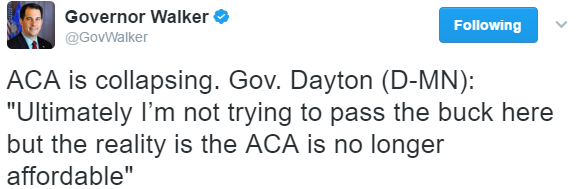
Walker lied about ACA collapse in Minnesota with misleading quote from Gov. Mark Dayton.

Nothing for Scott Walker is exempt from deceptive exploitation. Take this recent tweet:


Wow, that would be breaking news if it wasn't so misleading. Dayton was referring to those on the exchanges who made too much money to qualify for a subsidy. That's not the story Walker wanted you to know, but then what's new? 

Dayton is doing what Walker isn't; he's helping make health care more affordable to higher income Minnesotans because he cares. Walker is not.

I'll try to simply...

Gov. Dayton decided to help those buying insurance on the exchanges who were unfairly paying their full premium, no subsidy. My own brother complained about that last month. Here's the big story that hit the fan in Minnesota, the story Dayton was addressing in the "quote" above:
A Wabasha County Sexton family who is seeing a nearly 40-percent spike in premiums … the Sexton family paid $1,585 a month for insurance coverage. This year, their monthly premium jumped to $2,197. That's a hike of nearly 40 percent. For farm families, the fluctuating prices of milk make paying for increased premiums even tougher.

Gov. Mark Dayton proposed a 25-percent health insurance premium rebate for those who purchased their insurance on the individual market, but don't qualify for federal tax credits. The governor said the plan would help about 125,000 Minnesotans. Thanks to the premium relief the Legislature and the governor authorized in late January, Sheri and Vince will save about $6,600 on their annual premiums this year.
Simply put...
The Governor’s direct relief would reduce average 2017 rate increases from 55 percent to 16 percent for individuals with incomes over $47,520 and families of four with incomes over $97,200, but who did not receive federal tax credits.
It gets even more embarrassing for Walker when you see what Dayton proposed a few weeks later:
In 1992, Gov. Arne Carlson and legislators from both parties created MinnesotaCare — a state-operated health insurance plan. We believe that Minnesotans should have the freedom to buy their health insurance through MinnesotaCare. Their premiums would cover the full cost of their policies, so there would be no ongoing subsidies from the state. The MinnesotaCare "Buy-in Option" would provide a more affordable choice for another 100,000 Minnesotans, who now buy coverage for themselves or their families on the individual market.

Another strong benefit of this proposal, particularly for Minnesotans in rural areas of the state, is the broad networks of physicians and care providers available through MinnesotaCare.
You'll notice Dayton is talking about everyone in Minnesota, INCLUDING rural areas. Dayton is a proactive governor who continues to try and solve problems.

Saturday, February 25, 2017

Republican Rep. Burgess on 20 million losing health insurance: "...that's a good thing because we restored personal liberty in this country."

Republicans are just defending freedom and liberty. It's that natural born God give freedom and liberty to buy things, or not buy things. You might say freedom and liberty is based on consumer demand.
1. That's why Arizona Republicans don't have a problem with arresting protesters and seizing their property, despite being a First Amendment right, because it doesn't have anything to do with buying things.

2. That's why they hate corporate boycotts, because it's unfair and asks people not to buy things.

3. It also explains why money is speech, because it buys things. 
It all starts making sense when you see what makes them spitting mad; not being able to buy big gulps, incandescent light bulbs, guns, and now...being forced to buy health insurance! Goodbye freedom and liberty.

Even though 20 to 30 million people may lose their ability to buy health insurance once the ACA is repealed, that's not a Republican concern. What's really important is having the freedom and liberty to buy or not buy insurance, says Republican Rep. Mike Burgess of Texas::
“First off, we’re not going to send an IRS agent out to chase you down and make you buy health insurance. So if the numbers (of insured people) drop I would say that’s a good thing because we restored personal liberty in this country.”
 Burgess built his argument on Rep. Paul Ryan's original free market concept:


From the New Republic’s Brian Beutler, Ryan and Burgess got it all wrong: 
...since Obamacare’s major accomplishment was to counter those forces, and thus enable people to get health insurance, that in turn opened up whole new areas of personal freedom: the ability to take risks and get new jobs, or start new businesses, and or simply have a sense of security and peace of mind. So how exactly would it be a victory for “freedom” to pull out the rug from those who can finally buy health insurance?
MSNBC's Steve Benen took the words right out of my mouth:

Under the Republican approach, Americans can have the “personal liberty” of not receiving needed medical care. We can all be “free” to ration health services based on our individual wealth.

Ryan believes “freedom is the ability to buy what you want to fit what you need,” but the Speaker may not understand the point of insurance: we don’t always know what we’ll need, which is why we seek medical coverage in the first place.

I look forward to Republican policymakers telling countless Americans, “Your family is one serious illness away from financial ruin, and your health is at risk from treatable ailments, but look at how great your liberty is!”
Note: No matter how much sense the above positions make, you'll never hear Democrats pick up on any of these simple points and go on the offensive. Nope, it's like nothing happened.

Friday, November 4, 2016

Recycled Republican candidate Kapanke longs for days before Affordable Care Act, when fewer Wisconsinites had Insurance.

At a recent debate, former state Sen. Dan Kapanke, R-La Crosse, tossed out more misinformation that conservative voters would naturally think was right. WPR:
Kapanke favors ending the federal ACA. Even before the recent announcement ACA premiums were going up, he didn't believe the program worked. 
"We need to go back to where Wisconsin was prior to Obamacare where we did have 90-plus percent of our people covered with some kind of health care insurance."  
That was deceptive and wrong. 
A Kaiser Family Foundation report suggests 93 percent of the state's residents were insured through either employer-based insurance or government programs in 2015, up from 91 percent in 2013 before the ACA began. 
Let's Get It Straight: I'm tired of hearing Republicans brag about how Wisconsin was a leader in insurance coverage. The reason we covered so many Wisconsinites? We opened BadgerCare up to those making up to 200% of the federal poverty level, which Scott Walker and his band of plundering Republican pirates threw overboard immediately:
Scott Walker canceled Medicaid coverage for 77,000 people who have incomes above the poverty line. It (once) allowed people making up to 200 percent of the federal poverty level to be covered by BadgerCare ... the governor ... roll(ed) BadgerCare eligibility back to 100 percent of the poverty line.
And that's why back in 2013, Wisconsin's insured fell to just 91%. Now it's at 93%, thanks to enrollment in the ACA's Marketplace. But those stuck between 100%-200% are still having problems getting health care on their tight budgets: 


Oddly, this is the Republican mantra now, repeated below by Dumb Ron Johnson. Russ Feingold of course had to explain why that was a bad idea to the drooling GOP mob hoping to lose their own health care someday:


Monday, October 31, 2016

Republicans at fault for ObamaCares big rate increases!!! Real Fiscally Conservative-like.

LA Times columnist Michael Hitzik's "Inside those big Obamacare rate increases: State hostility to the law costs residents plenty," should start waking up even hard core stingy conservatives.

Journalists everywhere are starting to acknowledge publically, in their articles, that Republicans aren't really about saving money. Hitzik's article is just another example. It's now becoming very obvious Republican voters are okay paying more for everything if it means their party is in control and cutting government. Despite these increases, many won't see much a of difference because of their subsidies:
On average, states that have been hostile to Obamacare are facing the largest premium increases for 2017. Residents in states that have embraced the law will do much better. Charles Gaba, that indispensable tracker of ACA rates and policies, has fleshed out this phenomenon by comparing the weighted average premium increases for states that implemented the ACA cooperatively, even enthusiastically, with the increases in states that have resisted.
1. He finds that the weighted average rate increase for states that expanded Medicaid is 22.1% for 2017; among the 19 states that still have not expanded the program, it’s 28.9%.

2. In states that formed their own marketplace to enroll Obamacare consumers, the increase is 17.3%; among those that rely on the federal government’s exchange, healthcare.gov, it’s 28%.

3. Finally, among states that refused to allow consumers to remain in pre-ACA insurance plans that didn’t comply with the new law as of 2014, the weighted average increase is 18.8%; among those that capitulated to hysteria over canceled pre-ACA insurance plans by grandfathering the non-compliant plans for as long as three years, it’s 28.4%.Put these three factors together, and the states that fully embraced Obamacare will see increases of 18.2%. Those that fully resist will see increases of 29.8%.

4. The enrollment figures include on-exchange buyers and those who have purchased individual plans off the exchanges. The premium rates are pre-subsidy; the vast majority of exchange enrollees are eligible for government subsidies that can cut their monthly costs to as little as a few dollars per month.

5. The two states with the lowest increases, for instance, are bluer-than-blue Rhode Island and deep-red North Dakota.

6. The biggest divergence is between states with their own marketplace exchanges and those using the federal healthcare.gov ... it’s possible that the refusal serves as a proxy for all the silly, niggling ways a state government can throw obstacles in the way of Obamacare, such as refusing to fund “navigators” to help residents find the best plan for themselves, or failing to negotiate with insurers to secure the best prices.

7. The federal government’s decision to allow noncompliant plans to remain in effect was a reaction to a political uproar over cancellations of old plans, that “if you like your plan, you can keep it.” This always was a bogus controversy. As we observed at the time, the notion that loyal customers were being deprived of plans they absolutely adored, like the family dog, was almost certainly mythical.

8. Expansion states have lowered their uninsured populations and costs to local hospitals of uncompensated care. Moreover, according to the Kaiser Family Foundation, “states expanding Medicaid have realized budget savings, revenue gains, and overall economic growth.” Throw in Gaba’s findings of larger premium increases, and expansion Medicaid looks even more like a no-brainer. That should raise questions about the brains inhabiting the statehouses of the states still turning it down.
There is an important exception:
Minnesota, where the weighted rate increase is more than 55%, in part because the state’s basic health plan appears to have siphoned off a large number of people who would otherwise be in the Obamacare pool, driving up costs for the latter ... just a few years ago, Minnesota had among the lowest premiums in the nation. Minnesota is in worse shape because it has an unusually small individual market with an unusually large number of sick people.
Keeping the your old policy, what that means: Why did so many Republican states let those old policies continue? Well, they didn't do it because it saved people money; off exchange policies did not get subsidies...not a good way to pay a whole lot less:
Many health economists thought that grandfathering old plans was a bad idea. Their policyholders had been cherry-picked as low-risk customers, and keeping them out of the overall individual insurance pool was sure to force rates in the pool higher, while fostering confusion among insurers about the market they were serving in the ACA. Those concerns tended to be well-founded.
Expanding Medicaid is again a really good idea and money saver for states:


The Journal Sentinel's Guy Boulton broke it down what this means in the Milwaukee area, and the cost of health care is jaw dropping. The scam of high deductibles, co-pays and separate high deductibles for drug coverage proves insurers have gone too far.
A family of four, in which the parents are 40, would pay $13,157 a year, or $1,096.46 a month, for insurance — and that’s with a $10,400 medical deductible and a separate $7,000 deductible for prescription drugs, up to the $14,300 limit on out-of-pocket expenses for family coverage next year.

The plan, offered by Common Ground Healthcare Cooperative, is one of the least-expensive in Milwaukee County. “I’ve talked to people who are exasperated,” said Todd Catlin of Transition Benefits in Brookfield. “They are just at wit’s end.” Yet the cost is roughly in line with what employers and employees pay for insurance.
Important to remember...
“Health insurance was expensive before the Affordable Care Act,” said Donna Friedsam, director of Health policy programs at the University of Wisconsin Population Health Institute. “The difference is that people who could not get coverage before can get coverage.”

Tuesday, October 25, 2016

Health Care Ripoff part 3: ObamaCare premiums increase, thanks to Insurance industry Greed!!!

Ouch, health care insurers are increasing premiums on ObamaCare exchanges by double digits. I guess that would mean the smaller single digit increases weren’t as bad as Republicans said they were.

As I been saying here for years, insurers would eventually find a way to game the marketplaces and poison reform. Paul Ryan knew this when he said ObamaCare would collapse.

In the bad old days before the ACA, premiums increase every year between 20 and 50%. Oh, surprised? A short recap:
In August 2008, about six months before debate began in Washington on what would become the Affordable Care Act, 82 percent of Americans were so dissatisfied with the U.S. health care system they wanted it overhauled.

The main reason so many of us were uninsured in 2010 was that health insurance had simply become a budget-buster for many American families. The cost of employer-sponsored family coverage reached $13,375 in 2009, an increase of 131 percent in ten years, according to the Kaiser Family Foundation.
 
And almost 18 percent of our GDP is consumed by health care expenses, compared to 11.7 percent in France and 11.3 percent in Germany.  
Under Bush, the average family premiums (including both what employers and employees pay) went up $4,677 in his last six years in office, from 2002 to 2008, an increase of 58 percent. Bush’s first six years that increase was 72 percent.
Note: think what would happen in a GOP free market system replaced the ACA, with no plan requirements and no marketplace to compare prices. Do you think prices would increase dramatically even with supposed “affordable,” “buy what you can afford” junk policies? God would they.

Insurance companies want more Money....and are in a full court press to pressure the government to give them more money to boost profits. It worked before, with Medicare Advantage, why not ObamaCare. Briefly, let’s go back 16 years, with former insurance exec. Wendell Potter:
HISTORY (OF HEALTH CARRIER GREED) REPEATS ITSELF-Profit-Minded

 
Health Insurers Will Likely Return to Obamacare Fold in 2017: 16 years and five months ago, after the close of trading at the New York Stock Exchange, my staff and I at Cigna disseminated a press release we knew would lead to a lot of angst in Washington, on Wall Street and around the country. Cigna to Curb Medicare-HMO Risk; This was the headline in the company’s hometown newspaper, the Philadelphia Inquirer: Cigna to Exit 13 Medicare Markets … 104,000 of Cigna’s senior-citizen subscribers were being dumped because the company wasn’t happy with how much the government was paying it to provide access to medical care for those folks.
Guess who instigated the Cigna scheme? The Republican inspired Balanced Budget Act in 1997:
Insurers had been unhappy with their pay from Uncle Sam since the passage of the Balanced Budget Act of 1997, when Republicans were in charge of both the House and Senate. The GOP wanted to rein in spending on “entitlement” programs ... It reduced Medicare spending by more than $100 billion between 1998 and 2002 … capped annual reimbursement increases 2 percent on average...(but) medical inflation was averaging 8 percent annually. The companies clearly were not managing medical costs nearly as much as they had told lawmakers and their customers they would be able to do. So Cigna, at least, had decided to cut bait.

Fast forward to August 15, 2016 and the era of Obamacare. That was the day Bloomberg ran this angst-producing headline: Aetna to Quit Most Obamacare Markets, Joining Major Insurers. Why? Because, once again, the big insurers were not only not making the profit margins they felt they should be making, they were losing money on this particular book of business. So, just like they did a decade and a half ago, they decided to cut those enrollees loose.

And they were spectacularly successful back in the early 2000s. In short order, there was a reversal in fortune — in the insurers’ favor. So if the past is prologue, we can expect the insurance industry’s lobbyists to be hard at work to make sure history repeats itself. 


Keep in mind that the insurers’ Medicare + Choice losses were an unintended consequence of the Balanced Budget Act of 1997. Republicans in particular were alarmed when the insurers began abandoning the Medicare HMO market because it has long been a tenet of faith among many of them that private insurers could operate more efficiently than the traditional Medicare (TM) program, and consequently reduce overall spending on Medicare.
As you can see, this isn't an easy industry scam to explain. Here's more....
Congress Showed Health Carriers the Money: So halfway into the George W. Bush administration, with Republicans still in charge of both the House and Senate, the Medicare Prescription Drug, Improvement and Modernization Act of 2003 became law. The insurance industry’s lobbyists scored two big victories ... the prescription drug benefit (known as Part D) made it necessary for Medicare beneficiaries to buy their drug coverage through private insurers. And second, the Medicare + Choice program was overhauled to the industry’s liking (and renamed Medicare Advantage).

The government began paying private insurers more to cover the cost of sicker Medicare enrollees, so the companies that had bailed came rushing back in. There were also other provisions of the 2003 law that boosted the government’s pay to insurers. As a consequence, by the time Obamacare became law in 2010, the government was actually paying Medicare Advantage plans 14 percent more per beneficiary ($1,100 on average) than it would cost to cover those beneficiaries in traditional Medicare. Between 2004 and 2008, the overpayments totaled almost $44 billion.

One of the aims of Obamacare was to reduce those overpayments, and they have been reduced, but most insurers are still finding their Medicare Advantage business to be very profitable. You certainly don’t hear about insurers threatening to jump ship now.

You can also expect the insurers to lobby for more “flexibility” in designing their policies. They’d love to be able to go back to the days when they could sell junk insurance — policies with such meager benefits they rarely had to pay out much in claims.

Wednesday, September 28, 2016

Walker gives Health Care Costs a shove Upward, blames ObamaCare.

Republicans may whine about health care costs skyrocketing under ObamaCare, but it's all just a show. Thanks to Scott Walker and his band of plundering pirates, ObamaCare will cost more and wither away just like they said it would.

The irony? Walker's anti-ObamaCare supporters are now buying junk policies. And you know what, some of them deserve it.

Citizen Action of Wisconsin:
Walker Administration Deliberately Rigging Health Insurance System to Raise Rates: Almost as many people enrolled in substandard “lemon” health plans in Wisconsin as buy individual coverage through Healthcare.gov.
We know this because of an inadvertent admission by Deputy Insurance Commissioner J.P. Wieske during a recent hearing, that...:  
"...a much larger number of Wisconsinites than previously believed are enrolled in substandard health plans which do not meet the standards of the Affordable Care Act (ACA)."
Those stubborn and not so "fiscally conservative" Walker backers decided to "keep the plan they already had." 
In the hearing Wieske testified that 203,000 Wisconsinites are covered by so-called “transitional plans,” often referred to as “grandmothered” plans. Currently 239,034 Wisconsin health consumers are enrolled in individual coverage on Healthcare.gov. This means the ACA marketplaces in Wisconsin would be much larger if these transitional plans were prohibited.
People on these grandmothered plans...
...tend to be healthier, because the insurance corporations were still permitted at the time to discriminate against people with health conditions. Wisconsin exercised the option to continue these plans, while Minnesota and many other states working to improve health care access banned them.
Why keep the old plans? To slowly destroy ObamaCare by keeping half the people off the exchanges:
1. Substandard “lemon” plans increase prices in the ACA marketplace by skimming healthier people.This deprives healthier individuals from the ACA marketplace, leaving the remaining population sicker and costlier, and raising rates.

2. Even when they are cheaper, substandard “lemon” plans can be dangerous for health consumers when they face a major injury or illness. These plans often have gaps in coverage or extremely high cost sharing ... raising premiums by as much as 10 percent and decreasing enrollment” (Rand Corporation). “Integrating these underwritten members into the ACA pool is expected to improve the health status of the market as a whole, which could lower the relative cost of coverage on average.” (Milliman Actuaries)
So there you have it. And we keep electing people who hate government so much they'll do anything to make it worse:
“It is hard to escape the conclusion that the Walker Administration is deliberately trying to destabilize the Affordable Care Act by allowing insurance companies to skim healthier consumers,” said Robert Kraig, Executive Director of Citizen Action of Wisconsin. “The impact of this policy is to rig the health care system against Wisconsin families ... The only party who benefits from the continuation of lemon health plans is the insurance industry, which is allowed to continue to profit by separating the healthy from people with health conditions.

Monday, September 26, 2016

ObamaCare Exchanges not a job killer, and Americans auto enroll instead of forcing insurance companies to compete, resulting in higher prices.

It looks like Americans don't have enough time in their busy lives to shop for health insurance. It's crazy really, going through the ritual of picking the least draconian plan year after year, just to save lots of money. Too much work.

Nothing could be easier than going online and comparison shop for insurance. But that's not happening, resulting in higher prices for those seeking insurance.

Here are two important ObamaCare facts recently revealed by the Kaiser Family Foundation:
1. Obamacare was not a job killer: One of the more prevalent concerns surrounding Obamacare's implementation of the employer mandate -- the actionable component of Obamacare that requires employers to offer health coverage options if they have 50 or more full-time equivalent employees (FTE) -- was that it would coerce employers to reduce full-time employees to part-time, or it would result in job cuts.

Since Obamacare was officially launched, 7% of employers with 50 or more FTE bumped part-time workers up to full-time compared to just 2% of employers who cut full-time workers to part-time. 
2. Competition among insurers is a genuine issue: For starters, competition among insurers is actually declining. 

The other issue is that we're not seeing consumers necessarily making informed purchasing decisions with the information afforded to them. In each of the past two years millions of Americans have auto-enrolled in their previous year's plan, which is a potentially terrible idea. Plan coverage options and premiums change each year, and what may have been the best value one year may not be the next. What this essentially demonstrates is that the consumer isn't taking the time to shop around, which is further putting pricing power back into the hands of insurers. 


Wednesday, September 21, 2016

Health Care Costs Increase, but not because of the Affordable Care Act!

Even during the run-up to the Affordable Care Act, the media and health care pundits never brought up the deplorable state of our private insurance based system.

I remember it well as a small business owner because I had to shop in the individual market every year after receiving huge premium increases to re-up. While the media claimed increases somewhere around 10%, mine were 20 to 30%. Looks like I was right. LA Times:
Family premiums have increased 20% over the last five years, which is a lot but a darn sight better than the 31% hike over the previous five years, and a huge improvement over the staggering 63% growth in the five years before that.
A look at the latest stats will probably prompt Republicans to blame ObamaCare for increased health care costs, but that would be a lie. Here's the headline:
Sick: The biggest increase in healthcare costs in 32 years: The U.S. Labor Department reported Friday that spending on healthcare rose last month by the biggest amount (1%) in more than three decades.
But it’s wasn't ObamaCare's fault, or even insurance companies jacking up premiums; blame hospital costs and drug prices. This is very important to understand;
The overall price of medical treatment increased by 1% in August … the largest monthly gain since 1984 … The cost of hospital services climbed 1.7% in August, the biggest gain since October 2015, while the average price of prescription meds jumped 1.3%. That means average drug prices are up 6.3% over the last 12 months, the largest such increase in two years.
Health care is NOT a Consumer Product: The most egregious mistake Republicans like Paul Ryan make is treating health care like a consumable product. We don't "shop" for care, but receive it when we are least able to do anything but get immediate medical help.

Ghoulish Health Care Profits: Republicans must think buying health insurance makes this a consumer product, but ridiculous. In other industrialized countries, there are strict laws barring anyone from profiting off of the sick and dying. Makes sense, right? And that should be a dilemma for Republicans, but isn't because...
This country already spends $3 trillion annually on healthcare. That represents about 17% of total economic activity. The average for all nations within the Organization for Economic Cooperation and Development is 9%.

It’s deeply worrying that one of our most robust and reliable engines of economic growth is the business of sick people. Unless, that is, having the biggest hospital and drugstore bills is a point of pride.
It's a nasty revelation that I hope a few conservatives might start thinking about.

The other big topic I’ve been shouting about for years; Workplace Employee Deductibles and Health Savings Accounts, a Republican idea that brings about self rationing and bankruptcy so sick people have "skin in the game," like they don't already have a lot to lose:
Many Americans are paying more out of pocket for healthcare as they try to keep a lid on monthly premiums by accepting higher insurance deductibles … annual family premiums for employer-sponsored health plans are up an average 3% to $18,142 ... high-deductible plans shifting a greater share of the spending burden to patients … insurers keeping costs down by providing less-comprehensive coverage. Twenty-nine percent of all U.S. workers are now in high-deductible plans, up from 20% two years ago, according to Kaiser.
And what about drug prices?
A recent report from the Government Accountability Office found that while the average price of generics has come down in recent years, more than 300 generic meds have experienced “at least one extraordinary price increase of 100% or more.” Investigators found 15 generic meds that have seen price hikes of more than 1,000%.

Monday, May 30, 2016

Competition on ObamaCare exchanges worked!!! Lowered premiums!!! Now Insures want Out Due to Lower Profits!!!

Republicans think you forgot how our old health care system, before “ObamaCare,” failed miserably.

Who the hell is nostalgic for the days when insurers dropped people with pre-existing conditions, jacked premiums and deductibles up to unaffordable levels, and allowed insurers who cherry pick the healthiest Americans?

Since when do we rank health care by how much insurers make?

Hello, treating the sick and dying…remember that?

Now see how Forbe’s packages the Affordable Care Act as a failure because it cut insurance company profits, while saving you and me money. It should be a shock to your sense of humanity:
The story is similar for other insurers. Many have decided to abandon markets they have long served. That’s left people fewer options for coverage. And with less competition on the exchanges, the plans that remain have more freedom to hike premiums. Obamacare’s ongoing dysfunction is bad enough. But the looming collapse of its exchanges is prompting calls for even more government involvement in health care — even a single-payer system.
Competition Worked, Lowered Prices - now Insurers Want Out: Flipping market competition on its head, suddenly lower prices are bad...for them? Think about that; competition made insurers cut their premiums, which is now making them drop out of the exchange. If anything, the ObamaCare exchanges worked too well.

Forbe’s also wants you to think the ACA is “government” health care, when in fact it’s just a mall for private insurers:
It takes a special kind of reasoning to respond to the spectacular failure of government that is Obamacare by calling for, well, even more government.
Their Loss is Our Gain: Think of the next statement as money we saved shopping on the exchanges, and not money insurers “lost.”
Health insurance companies lost as much as 11 percent on their exchange plans last year. That’s more than double the amount they lost during the exchanges’ first year.
The following anti-competition group of insurers is part of a rogue’s gallery of blood thirsty profiteers, salivating for a Paul Ryan style plan of junk policies offering a la carte services (what you can afford) and loop holes you could drive a Mack truck through (small print legalese):
Insurers have responded by heading for the exits. UnitedHealth will now only sell health plans in three states. Humana abandoned several markets after posting a 46 percent drop in earnings. Premera Blue Cross will leave Oregon and a dozen counties in Washington State.
Want competition to work, stay away from these ghouls.

Promise? Not Quite: My own brother is pretty well off and told me how angry he was that he didn't at least get some kind of deal under the exchanges. I agreed, upper middle class folks should get something, but it wasn't like he'd go broke paying his own way. I know for a fact he would never go without coverage. Which brings me to the articles final statement.
These subsidies don’t apply to millions of middle-class people. To afford premiums, many must cut other parts of their household budget — or go uninsured.

The Obama administration promised that this wouldn’t happen. The White House said that Obamacare would “curb excessive premium growth for . . . millions of Americans.” It said that ... creating online exchanges would yield a marketplace where insurers competed on price and quality. But many Americans have not benefited. One in two disapproves of the law.
"...creating online exchanges would yield a marketplace where insurers competed on price and quality" and it worked, lowering prices and hurting insurance company profits. Cry me a river.

Saturday, April 16, 2016

ObamaCare proves, Insurers can't make money when they have to compete.

The fantasy that health care will ever become competitive under the ACA or a Republican market based plan is proving to be complete nonsense. Insurance companies are proving that point over and over again, inadvertently admitting they have no desire to compete under any scenario.

Irony: When Republicans tell us how horrible ObamaCare is, they're also admitting to the failure of the insurance based system. It didn't work before ObamaCare, it's hardly working now. And the GOP's market based plans assume insurers will stand by letting Americans buy cheaper policies, which is just plain crazy. They've got share holders to answer to.

In another article about the impending collapse of the ACA's marketplaces, the focus is always on insurer profits, and not on health care. Notice that? The Hill:

Insurance companies can't make money competing, it's that simple:   
Insurers warn losses from ObamaCare are unsustainable: Insurers say they are losing money on their ObamaCare plans at a rapid rate, and some have begun to talk about dropping out of the marketplaces altogether ... some observers have not ruled out the possibility of a collapse of the market, known in insurance parlance as a “death spiral.”
Pricing is a problem for insurers when people can easily shop and compare plans in one place. That won't be possible buying insurance across state lines or through advertising from junk mail. 

The line that says it all? 
Larry Levitt, an expert on the health law at the Kaiser Family Foundation said, “There are enough people enrolled at this point that the market is sustainable. The premiums were just too low.”
Yea, thanks to competition! Am I crying alligator tears for prices that are too low? Are you kidding?
Another risk, should regulators reject large premium increases, is that insurers could simply decide to cut their losses and drop off the exchanges altogether.
Like my conservative friend in Milwaukee said, single payer is trouble free and easy, a lesson he learned after being on BadgerCare for awhile.

Wednesday, April 13, 2016

ObamaCare premiums increased 4%, because Americans shopped for a better deal on the Exchanges.

I’ve been reading massive amounts of misinformation, from the Wall Street Journal to the Business Insider, about ObamaCare's supposed huge premium increases. Every one of these articles falsely portrays insurers as having an important roll in our nations health care system, which they do not. They're even crying alligator tears over insurers dwindling profits. 

The ghoulish idea that business should make a profit on human pain and disease is at the heart of the Republican free market health care plan.

In an attempt to straighten out the facts once and for all, I found this accurate report from Huffington Post's health care reporter Jonathan Cohn. Here’s the shortened version:
If you follow the news or listen to the Republican presidential candidates, then you’ve probably heard that premiums for some Affordable Care Act plans went way up last year.

But now the Obama administration is saying that, for the vast majority of people buying coverage through healthcare.gov, premiums are only 4 percent higher than they were last year.

Approximately 9.7 million people got insurance through healthcare.gov this year. 

85 percent of healthcare.gov consumers got at least some assistance. They are the ones who, on average, are paying just 4 percent more for their insurance than they were last year. 

For that small portion of consumers not eligible for assistance, and paying full price, premiums this year went up by more — 8 percent, to be precise. 

But by historical standards, that’s hardly outrageous. In the years right before passage of the Affordable Care Act, the average annual increase for individual coverage was more than 10 percent, according to research by MIT economist Jonathan Gruber and the Commonwealth Fund.
 So why all the fuss about skyrocketing premiums now? One reason is that Obamacare critics don’t mention the law’s tax credits, which can discount the price of coverage by hundreds or even thousands of dollars a year. In addition, the numbers in the HHS report represent averages. They include some big premium hikes (which the law’s critics hype) as well as some reductions (which those critics largely ignore). 

But there’s another big reason: More than 40 percent of returning customers shopped around, dropped the plans they had in 2015, and decided to pick new ones for 2016.

You could argue, credibly, this is what competition is supposed to look like — with insurers vying for market share, consumers hunting for bargains, and the whole process putting pressure on the providers of medical care to lower their prices. In the old days, most people couldn’t shop for plans, because lack of standard benefits made it difficult to compare plans and insurers didn’t want to cover people with serious medical problems (Republicans want to go back to this-jp). But while some insurers have threatened to withdraw from Obamacare marketplaces, and one carrier, UnitedHealth, recently pulled out of Arkansas and Georgia, others remain committed to the program. They say they expect the market to stabilize once they develop a firmer sense of the kind of people buying insurance and the policies they prefer. In the meantime, if premiums keep rising, consumers will probably keep switching, seeking out lower prices from whatever insurers provide them.
Note: Imagine what would happen under the GOP's free market version of health care; will insurers be happy when Americans buying only their cheapest plans. That's what Republicans say will happen, "buying what you can afford." Insurers will quickly game the system and raise premiums on junk policies that will cover very little, jacking up co-pays and deductibles to unaffordable levels. They're already finding loopholes in the exchanges.

My conservative friend in Milwaukee called me about the movie The Big Short, and ironically told me about how the Wall Street banks gamed the system, never thinking the same could said about health insurers, big oil etc.. I'll bet he still thinks getting government regulation out of the way is the solution.

Saturday, March 5, 2016

"Stand with Walker" voters like Wasting Money, and Lots of it if it makes their point about ObamaCare.

While the national media tore Scott Walker a "new one," state reporters just don't seem to get the ins and outs of the Affordable Care Act...accept for Guy Boulton:
Wisconsin uses Affordable Care Act but rejects funding for it: Guy Boulton-Journal Sentinel: Wisconsin's decision last week to challenge a fee imposed by the Affordable Care Act set up a comparison not lost on advocates who support the law.
So is Walker saving taxpayers money?
The fee has cost the state about $23 million so far ... Gov. Scott Walker and the Legislature's opposition to the law is projected to cost $678.6 million in state tax dollars through the 2017 fiscal year.
That doesn't sound too taxpayer friendly. But as with all conservative ideas, if it's their law, wasting money doesn't matter...it's the principle:
Wisconsin is the only state in the country to use the Affordable Care Act to expand its Medicaid program while turning down the additional federal dollars ... to pay for it.
As we all know, Republicans don't like paying for anything. Life is a free ride to them. So what's behind this Walker/Schimel lawsuit that has them so riled up? Let's start with Walker's cockeyed crazy reasoning...remember, this is costing taxpayer $23 million plus $678 million through 2017:
"Once again, we are taking action to protect Wisconsin taxpayers from the adverse effects the Obama administration's Affordable Care Act has on our citizens. This lawsuit is meant to ensure Wisconsinites are not left paying this unconstitutional and coercive tax..."
But what's obvious to everyone else is this:
"He's looking for pennies on the floor of his car, when he should be looking at the bags of money in front of him," said Bobby Peterson, executive director of ABC for Health, a public interest law firm.
Taxpayers are currently paying about 42% of the Medicaid bill, instead of ZERO and just 10% after that. No, you don't have to be a math genius to figure this one out:
Under the Affordable Care Act, the federal government initially would pay the full cost of covering poor people previously not eligible for Medicaid through 2016, with the federal government's share gradually dropping to 90% by 2020.
Bullshit: Walker is peddling bullshit with little persistent blowback by the media, who could have stopped this lunacy in its tracks. Notice the word "contend," that allows this bullshit to continue unchallenged:
The Walker administration and others have contended that the federal government eventually will reduce the money available to states through the law because of persistent U.S. budget deficits.

The federal government cannot meet its current Medicaid obligations, Laurel Patrick, a spokeswoman for Walker, said in an email ... "We maintain that states should not depend on the use of uncertain federal funds, which is why Governor Walker implemented unique reforms ..." Patrick said.
This is why Wisconsin isn't getting back every dollar we send to Washington:
As of June 30, the state had passed up an estimated $227.6 million available through the law, according to the Legislative Fiscal Bureau. More than $200 million will be added to the tab in the current fiscal year.

"He's just completely tone deaf on this issue, and he's not running for higher office anymore," Peterson said of Walker. "He ought to consider going after this money instead of these obscure objections to the ACA. "At some point they need to move on," he said.
Walker's biggest problem? An actual law designed to pay for itself:
The fee on insurance companies was among the myriad taxes imposed by the law to help pay for the cost of expanding insurance coverage. By requiring states to reimburse the insurance companies, also known as managed care organizations, for the fee, the federal government has imposed the taxes on the states, the lawsuit alleges.

Timothy Jost, an emeritus professor at the Washington and Lee University School of Law and an expert on the complexities of the Affordable Care Act, said he doesn't believe the lawsuit has much merit. "The states don't have to participate in Medicaid," Jost said. "But if they do, they have to play by the rules, and this is a pretty garden-variety rule." Jost wrote that the states also pay substantial amounts to cover other federal taxes paid by Medicaid managed care organizations, such as payroll taxes.
Putting up the appearance of "looking out for the taxpayer," watch for the Walker's medicine show in a location near you:
"We have and will continue our work to protect taxpayers from the costly consequences of the ACA," Patrick said in the email.

When ObamaCare saved a Republican's life!

Scott Walker is wrong, but you'd never know it by his continued insistence to claim Medicaid money is not guaranteed. He can't let go of a good talking point, no matter how meaningless or false.

Walker's excuse rang hollow again after hearing the testimony of a satisfied Republican voter, who is still alive today thanks to ObamaCare. It saved his life. Medicaid expansion offers that same hope for thousands:
President Barack Obama called on Gov. Scott Walker to accept the federal Affordable Care Act (ACA) Medicaid expansion he turned down in 2013.
“Your governor still refuses to expand Medicaid in this state. We could cover another 21,000 Wisconsinites with the stroke of his pen. He’s denying Wisconsinites their ticket to health insurance, and it’s political.”
MSNBC's Chris Hayes picked up on the story, and interviewed Walker supporter Brent Brown:
Brent Brown, who introduced Obama, said the ACA saved his life after he was diagnosed with an autoimmune disease in college, because it allowed him to get insurance in spite of his condition. Brown, who is a Republican, urged legislators to “do what is right for the people.”

It's a Walker lie his supporters like: Has the federal government "reneged" on Medicaid funding?
...there’s a major problem in Walker’s contention.The federal share -- known as the Federal Medical Assistance Percentage, or FMAP ... fluctuates annually and varies from state to state based on a formula dating to Medicaid’s inception in 1965… "designed so that the federal government pays a larger portion of Medicaid costs in states with lower per-capita incomes relative to the national average.”

In other words, the standard federal share of Medicaid costs is not promised or guaranteed to hold steady; it must only stay between the statutory minimum of 50 percent and maximum of 83 percent. But typical cost-sharing fluctuations, based mainly on a longstanding formula, explain the extra state burden -- not any reversal of course or pulling back on a commitment by Washington. We rate Walker’s claim False.
Of course, as more Wisconsinites enter the ranks of poverty, the federal government will kick in more money. Much like a number of southern states. Maybe that's Walker's plan?

Wednesday, February 24, 2016

ObamaCare Exchanges give Providers Higher profits.

Update: The media played up UnitedHealth Groups publicity seeking threat to leave the ObamaCare Exchanges because they couldn't make as much money as they thought, boohoo, but as you can see here, they've been whining for some time.
Insurance giant UnitedHealth Group seemingly took another step closer to bailing out of Obamacare in 2017 ... UnitedHealth Group is the master of health care for profit. In 2004, United’s CEO William McGuire (an MD, woefully enough), received compensation of $125 million, obtained, you may be sure, by tens of thousands of denials .... UnitedHealth and CIGNA, funneled $86.2 million into the U.S. Chamber of Commerce in 2009 to pay for the Chamber’s multifaceted campaign to kill President Obama’s health reform legislation.
UnitedHealth Group was never a big player in the exchanges. Those that are do well. Insurers are making more in Wisconsin because the Walker administration isn't trying to control premium increases like other states...Minnesota is one. 

ObamaCare Marketplace Health Care Providers Profits Up: Providers are doing well, patients are doing well, so there's a lot to celebrate in southeastern Wisconsin. Remember, these are providers not insurers. JS Guy Boulton:
Health systems in the Milwaukee area have seen a sharp increase in profits since the expansion of health insurance through the Affordable Care Act. So far, the law has helped the bottom lines of health systems in the Milwaukee area. The same trend overall can be seen throughout the country. A key reason: Health systems are providing less charity care and incurring fewer bad debts. A slew of other factors — including health systems' work to control costs and become more efficient — contributed to the increase in profits in the Milwaukee area. Still, the numbers are telling:
■ Aurora Health Care's operating income was up 221% in 2014, increasing to $503 million from $156.8 million in 2013. For the first nine months of 2015, operating income fell slightly to $337.5 million when compared with the same period in 2014. But that was more than triple the operating income of $92.4 million reported for the first nine months of 2013.■ Wheaton Franciscan Healthcare's operating income was up 158%, increasing to $69.2 million compared with $26.8 million in its 2014 fiscal year.■ ProHealth Care's operating income was up 125%, increasing to $37.8 million compared with $16.8 million for its 2014 fiscal year.■ Froedtert Health's operating income was up 79%, increasing to $149 million compared with $83.4 million in its 2014 fiscal year.■ Columbia St. Mary's operating income was up 26%, increasing to $26.1 million compared with $20.7 million in its 2013 fiscal year.
At least some of those gains have come from the increase in people with health insurance, either through the subsidized health plans sold on the federal marketplaces or the state's partial expansion of its Medicaid program. For example:
■ Froedtert Health's bad debt expense fell by $40.2 million, to $33.2 million, while the cost of providing charity care fell by $14.2 million, to $7.6 million.■ Wheaton Franciscan's bad debt expense fell by $29.6 million, to $44.9 million, while the cost of providing charity care fell by $15 million, to $34.5 million.
At the same time, the health systems are seeing more patients, in part because people previously uninsured are likely to schedule an appointment with a doctor. Many people who have gained coverage have commercial insurance, which pays higher rates.
While Republican health care plans focus on supposed free market principles that maintain the expensive and abuse prone fee-for service model, real reform in logically moving away from that:
Health systems also are preparing for the expected move away from so-called fee-for-service — in which they are paid based on the services they provide — to new payment models that could put more focus on costs and quality.