Showing posts with label Gov. Mark Dayton. Show all posts

Wednesday, May 23, 2018

The Walker Wisconsin Comeback Mirrors Kansas, not Minnesota's Success!!!

A report comparing Democratically run Minnesota and swirling Republican pit of Wisconsin is getting a lot of attention. The Economic Policy Institute (EPI) compared actual economic numbers based on policy pushed by both Minnesota Gov. Mark Dayton and Wisconsin's Scott Walker.

Note: Walker continues to use the GOP's Great Recession against the Democrats like it was their fault, and oddly brags about an Obama economy Republicans criticized as "too slow." See if you can see a moment where Walker's trend line below did not mirror the national trend.

The irony, Walker posted the proof himself:


Minnesota Jobs Beat Wisconsin's: It's clear supply side/big corporate servitude does not serve the public or raise their incomes-provide health care-produce green energy and create jobs. Before we take a quick look at the differences, the U.S. Bureau of Labor Statistics, the "gold standard" of job metrics, reported...WPR:
Minnesota Passes Wisconsin In Total Jobs ... 2017 Was The First Year In Recent History That Wisconsin Fell Behind Its Midwest Neighbor ... Minnesota nudged ahead of Wisconsin by 3,096 total jobs. Wisconsin still has almost 219,000 more residents than Minnesota, and just a decade ago, it had nearly 98,000 more jobs.
University of Michigan Labor Economist Donald Grimes said what stuck out to him was that Minnesota had added more jobs than Wisconsin every year since 2010. "The fact that it's every year is somewhat remarkable," Grimes said.

Minnesota smokes Walker's Participation Rate: Oh, and what about Walker's biggest bragging point, and a preoccupation of the far-right, the labor participation rate?
Minnesota's labor force participation rate — the percentage of the overall population that is part of the workforce — is 70.5 percent, which is slightly higher than Wisconsin's 68.9 percent.
Walker's war with Milwaukee Killing Jobs: You'd think the former executive of Milwaukee County would show a little more kindness. Also, you would have thought Milwaukee's close proximity to Chicago, creating a possible economic hub, would give it an advantage over lonely Minneapolis-St. Paul:
In addition, job growth in Minnesota's largest city far surpassed job growth in Wisconsin's. Hennepin County, Minnesota, home to Minneapolis-St. Paul, added 110,520 jobs from 2011 through 2017. By contrast, Milwaukee County, Wisconsin added just 17,680 over that same period.

"You need to focus on why Milwaukee is doing so much worse than Minneapolis-St. Paul and how you can be more like Minneapolis-St. Paul," Grimes said.
EPI's Minnesota vs Wisconsin report started this way...
Governor Walker and the Wisconsin state legislature have pursued a highly conservative agenda centered on cutting taxes, shrinking government, and weakening unions. In contrast, Minnesota under Governor Dayton has enacted a slate of progressive priorities: raising the minimum wage, strengthening safety net programs and labor standards, and boosting public investments in infrastructure and education, financed through higher taxes (largely on the wealthy) ... a compelling case study for assessing which agenda leads to better outcomes for working people and their families ... By virtually every available measure, Minnesota’s recovery has outperformed Wisconsin’s.
Urban Milwaukee summarized:
On every economic measure, Cooper found that Minnesota outperformed Wisconsin:
  • Job growth was markedly stronger in Minnesota than Wisconsin.11.0 percent growth in total nonfarm employment, compared with only 7.9 percent.
  • Wages grew faster in Minnesota than in Wisconsin at every decile in the wage distribution ... rising by 8.6 percent and 9.7 percent, respectively, in Minnesota vs. 6.3 percent and 6.4 percent in Wisconsin.
  • Gender wage gaps shrank more in Minnesota than in Wisconsin ... women’s median wage as a share of men’s median wage rose by 3.0 percentage points in Minnesota, and by 1.5 percentage points in Wisconsin.
  • Median household and family income grew more in Minnesota than in Wisconsin. Minnesota grew by 7.2 percent from 2010 to 2016. In Wisconsin, it grew by 5.1 percent.
  • Minnesota made greater progress than Wisconsin in reducing overall poverty, child poverty, and poverty as measured under the Census Bureau’s Supplemental Poverty Measure. Wisconsin, at 11.8 percent was still roughly as high as the poverty rate in Minnesota at its peak in the wake of the Great Recession (11.9 percent, in 2011).
  • Minnesota residents were more likely to have health insurance than their counterparts in Wisconsin.
  • Minnesota has had stronger overall economic growth, stronger growth per worker, and stronger population growth than Wisconsin (12.8 percent vs. 10.1 percent), stronger growth per worker (3.4 percent vs. 2.7 percent), and stronger population growth (5.1 percent vs. 1.9 percent) than Wisconsin. In fact, over the whole period—as well as in the most recent year—more people have been moving out of Wisconsin to other states than have been moving in from elsewhere in the U.S. The same is not true of Minnesota.
 Now, tell me why Democrats are still having a hard time shaping a common easy to understand message? 

Monday, February 27, 2017

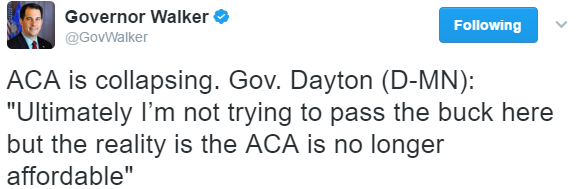
Walker lied about ACA collapse in Minnesota with misleading quote from Gov. Mark Dayton.

Nothing for Scott Walker is exempt from deceptive exploitation. Take this recent tweet:


Wow, that would be breaking news if it wasn't so misleading. Dayton was referring to those on the exchanges who made too much money to qualify for a subsidy. That's not the story Walker wanted you to know, but then what's new? 

Dayton is doing what Walker isn't; he's helping make health care more affordable to higher income Minnesotans because he cares. Walker is not.

I'll try to simply...

Gov. Dayton decided to help those buying insurance on the exchanges who were unfairly paying their full premium, no subsidy. My own brother complained about that last month. Here's the big story that hit the fan in Minnesota, the story Dayton was addressing in the "quote" above:
A Wabasha County Sexton family who is seeing a nearly 40-percent spike in premiums … the Sexton family paid $1,585 a month for insurance coverage. This year, their monthly premium jumped to $2,197. That's a hike of nearly 40 percent. For farm families, the fluctuating prices of milk make paying for increased premiums even tougher.

Gov. Mark Dayton proposed a 25-percent health insurance premium rebate for those who purchased their insurance on the individual market, but don't qualify for federal tax credits. The governor said the plan would help about 125,000 Minnesotans. Thanks to the premium relief the Legislature and the governor authorized in late January, Sheri and Vince will save about $6,600 on their annual premiums this year.
Simply put...
The Governor’s direct relief would reduce average 2017 rate increases from 55 percent to 16 percent for individuals with incomes over $47,520 and families of four with incomes over $97,200, but who did not receive federal tax credits.
It gets even more embarrassing for Walker when you see what Dayton proposed a few weeks later:
In 1992, Gov. Arne Carlson and legislators from both parties created MinnesotaCare — a state-operated health insurance plan. We believe that Minnesotans should have the freedom to buy their health insurance through MinnesotaCare. Their premiums would cover the full cost of their policies, so there would be no ongoing subsidies from the state. The MinnesotaCare "Buy-in Option" would provide a more affordable choice for another 100,000 Minnesotans, who now buy coverage for themselves or their families on the individual market.

Another strong benefit of this proposal, particularly for Minnesotans in rural areas of the state, is the broad networks of physicians and care providers available through MinnesotaCare.
You'll notice Dayton is talking about everyone in Minnesota, INCLUDING rural areas. Dayton is a proactive governor who continues to try and solve problems.

Saturday, January 31, 2015

Sunday, January 4, 2015

Walker loses to Minnesota, in Political Test of Ideologies.

One of the best articles yet comparing Minnesota's blue success with Wisconsin's red failure, appeared in the LaCrosse Tribune over the weekend. By every measurement it's embarrassing. And we reelected this guy? What are the consequences of the differing governing styles and legislative agendas? It will take your breath away:
Walker’s tax plan reduced the highest rate for the wealthiest Wisconsinites from 7.75 to 7.65 percent and brought slight relief to all income levels. Dayton’s plan created a new rate of 9.850 percent for the top 2 percent of Minnesota’s wealthiest. His plan also increased tax credits for renters — the opposite of Wisconsin, where those tax credits were reduced. Dayton also signed a $508 million tax cut in 2014 of which $232 million was aimed at the middle class and $232 million was earmarked for the elimination of some business taxes.

Minnesota has increased its minimum wage to $9.50 an hour and has it indexed to increase with inflation. Walker has said he does not support raising the minimum wage.

Dayton also signed a $508 million tax cut in 2014 of which $232 million was aimed at the middle class and $232 million was earmarked for the elimination of some business taxes.

While Wisconsin faces an estimated $2 billion deficit — including a $750 million deficit in transportation spending — Minnesota has a $1.2 billion surplus. Minnesota has the luxury of being able to invest in its state; Wisconsin faces some challenging spending decisions.
It doesn't stop there either...
Under Walker, Wisconsin has been a leader in cutting education spending. ranked No. 2 in the nation — behind only Alabama — with a $1,038 spending per student decrease. Minnesota was one of a handful of states that actually increases spending during that time.

Minnesota took Medicaid money and created its own health care marketplace, reducing the number of uninsured residents. Wisconsin rejected federal money ...  That cost the state an estimated $206 million over the past two years and an estimated $460 million through 2020.

The business-friendly policy embraced by Walker has resulted in private-sector job growth that continues to lag behind the national average. The latest 12-month period numbers that ended in June show Wisconsin 32nd in the nation in job growth. Minnesota was 26th. Minnesota’s jobless rate in November was 3.7 percent. Wisconsin’s was 5.2.

Forbes ranks Minnesota as the ninth best state for business, No. 7 in economic climate and No. 2 in quality of life. Wisconsin is ranked 32nd, 27 and 17 on the same measures. 

The cost of doing business in Minnesota is 0.2 percent below the national average. Wisconsin is 1.7 percent above the average. The median household income in Minnesota is about $60,000. It’s just below $52,000 in Wisconsin.

Clearly the ideology of both governors and legislatures steered the course. Walker is one of the nation’s most conservative governors who has eagerly embraced policies and ideas driven by the American Legislative Exchange Council, ALEC. Wisconsin has become a national laboratory for ALEC policies. 

An analysis done by Menzie Chinn, a University of Wisconsin economist, measured private nonfarm job growth in four states — California, Wisconsin, Kansas and Minnesota — that elected new governors in 2010. Wisconsin and Kansas are ALEC-friendly. Minnesota and California are not. Minnesota was ranked 46th and California ranked 47th on an ALEC-economic index that measures taxes, public employees per capita, minimum wage and right-to-work law — among others. Yet those states grew more jobs than Kansas (ranked 15th by ALEC) and Wisconsin (ranked 17th).

Chinn compared ALEC rankings to all 50 states and found the same correlation. States that received a higher ALEC ranking on how it was expected to perform economically based on 15 policy areas had worse economic growth when it comes to creating jobs.