Showing posts with label Health insurance exchange. Show all posts

Sunday, March 19, 2017

Patient + Private Business = Doctor? What's wrong with this equation?

Republican rhetoric is filled with "buying" insurance, the one thing that has nothing to do with treating sick people or promote prevention.

So we're not asking the most obvious question; why are we inserting a for profit business between a doctor and their patient? Think about how odd that is. And yet Republicans think this is normal, a sign of freedom?  

Actually, Republicans are just defending freedom and liberty. It's that natural born God give freedom to buy things, or not buy things.
1. In Wisconsin, Scott Walker tried and failed to make protesters buy a license to protest.

2. That's why they supposedly hate corporate boycotts, because it's unfair and asks people not to buy things.

3. It also explains why money is speech, because it buys things. 
Their anger is all starting to make sense; not being able to buy big gulps, incandescent light bulbs, guns, and now...being forced to buy health insurance? Goodbye freedom and liberty.

24 million people may lose their ability to buy affordable health insurance, but that's not a Republican concern. What's really important is having the freedom and liberty to buy or not buy insurance. 

Or how about the freedom to raise money on your own to help pay your medical costs:
A GoFundMe page that aims to help the family has raised nearly $90,000 in less than three weeks. The money will be used to cover medical costs and efforts to help him adapt to life without appendages.
Car washes and bake sales anyone?

Insurers will have total control over the price of health care services, not the free market. NOTE: A single payer system, where we can see any doctor or go to any hospital, actually does create competition between providers, right? 

Where am I wrong here? Why have we plopped a for profit middle man between a doctor and their patient. Is this really the place for someone to make a profit?

Monday, February 27, 2017

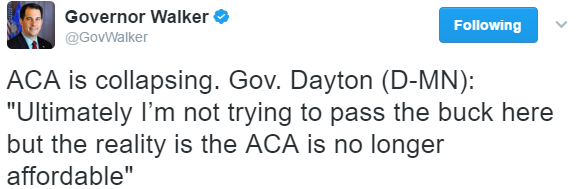
Walker lied about ACA collapse in Minnesota with misleading quote from Gov. Mark Dayton.

Nothing for Scott Walker is exempt from deceptive exploitation. Take this recent tweet:


Wow, that would be breaking news if it wasn't so misleading. Dayton was referring to those on the exchanges who made too much money to qualify for a subsidy. That's not the story Walker wanted you to know, but then what's new? 

Dayton is doing what Walker isn't; he's helping make health care more affordable to higher income Minnesotans because he cares. Walker is not.

I'll try to simply...

Gov. Dayton decided to help those buying insurance on the exchanges who were unfairly paying their full premium, no subsidy. My own brother complained about that last month. Here's the big story that hit the fan in Minnesota, the story Dayton was addressing in the "quote" above:
A Wabasha County Sexton family who is seeing a nearly 40-percent spike in premiums … the Sexton family paid $1,585 a month for insurance coverage. This year, their monthly premium jumped to $2,197. That's a hike of nearly 40 percent. For farm families, the fluctuating prices of milk make paying for increased premiums even tougher.

Gov. Mark Dayton proposed a 25-percent health insurance premium rebate for those who purchased their insurance on the individual market, but don't qualify for federal tax credits. The governor said the plan would help about 125,000 Minnesotans. Thanks to the premium relief the Legislature and the governor authorized in late January, Sheri and Vince will save about $6,600 on their annual premiums this year.
Simply put...
The Governor’s direct relief would reduce average 2017 rate increases from 55 percent to 16 percent for individuals with incomes over $47,520 and families of four with incomes over $97,200, but who did not receive federal tax credits.
It gets even more embarrassing for Walker when you see what Dayton proposed a few weeks later:
In 1992, Gov. Arne Carlson and legislators from both parties created MinnesotaCare — a state-operated health insurance plan. We believe that Minnesotans should have the freedom to buy their health insurance through MinnesotaCare. Their premiums would cover the full cost of their policies, so there would be no ongoing subsidies from the state. The MinnesotaCare "Buy-in Option" would provide a more affordable choice for another 100,000 Minnesotans, who now buy coverage for themselves or their families on the individual market.

Another strong benefit of this proposal, particularly for Minnesotans in rural areas of the state, is the broad networks of physicians and care providers available through MinnesotaCare.
You'll notice Dayton is talking about everyone in Minnesota, INCLUDING rural areas. Dayton is a proactive governor who continues to try and solve problems.

Wednesday, November 23, 2016

Health Care CEO's worried Republicans will throw insurance markets into Chaos over Lawsuit and Repeal.

Like I've said over and over, Republican politicians don't have a clue about health care, or how it works in the real world. Want proof? Apparently, Republicans never thought there was a health care problem in the first place: 
“People have crappy insurance,” Rep. John Shimkus (R-Ill.) told Politico last week. “This fear that they’re going to lose something that they don’t think they have anyway is crazy.”
George W. Bush once said we already had a national health care system, emergency rooms.

But health care is about to get a whole lot worse if Trump and Paul Ryan have their way, and there's nothing to stop them...unless....

...let's see if corporate CEO's opposition to repealing ObamaCare carries as much weight as their support for Walker's changes to Wisconsin's business climate, which we're never allowed to forget:


Modern HealthCare: Healthcare CEOs are willing to consider Trump's healthcare reform ideas. But they have strong concerns about whether his plan would match the ACA's performance in expanding coverage and slashing the uninsured rate to less than 9%, according to Modern Healthcare's post-election Power Panel survey.

Beyond the ACA, the CEOs surveyed stressed the need for action to curb the growth of prescription drug prices, with 60% saying that should be a top priority for the new administration and Congress.

86% of the CEOs responding to the survey either strongly or somewhat agreed that repeal should not proceed without a replacement plan that provides affordable health insurance for all Americans who lack employer-based coverage.
GOP ObamaCare Lawsuit could Crash Insurance Market: Republicans are now worried their lawsuit to repeal the insurance company safety net payments in ObamaCare may just crash the industry:
House Republicans have asked a federal appellate court to delay (an) appeal in a case that could end some payments to health plans and throw the individual insurance market into chaos.

If those cost-sharing reduction payments were eliminated, as House Republicans have sought, insurers either would have to sharply raise premiums or exit the ACA exchange markets. 

But some Republicans and health policy experts fear that any hasty, drastic moves would crash the individual insurance markets. They warn that ending the cost-sharing reductions without any replacement system might panic insurers by causing them to lose lots of money.
CEO's warn:
CEOs participating in the new survey worried that Republicans will put even more reliance on high-deductible health plans, which they believe are discouraging patients from seeking needed care. They also were wary of GOP proposals to restructure Medicare and Medicaid.

Monday, August 29, 2016

Next Year, Buy from Generic competitors to EpiPen.

Thanks for nothing. The company that upped the price on EpiPen's now wants to dominate the "generic" market with the same drug? I could be wrong but maybe just dropping the price would be easier than discount cards, insurance deals and a generic side product.
Click to enlarge
The drug maker's generic EpiPin will sell for $300, half the cost of its branded product. The move comes amid criticism from the public and lawmakers over big price hikes.
$300, what a break? It was just $100 back in 2009. Mylan of course wants to negotiate downward, while still raking in the higher prices paid by the poor and uninsured.

About a week ago, Mylan's CEO Heather Bresch said she was also frustrated by the price, despite ever really justifying the hike or proving the middleman fee structure changed that much (pictured below). The CNBC Squawk Box host Brian Sullivan did a great job of holding Bresch's feet to the fire:


The price of the EpiPen has soared 500% since generic drug company Mylan bought the treatment nine years ago. Yet Mylan’s controversial CEO Heather Bresch says she and her company aren’t solely to blame. 
Here's the chart (a little fuzzy) that supposedly passes the blame for the price increase onto the middlemen, and not poor Mylan:
"My frustration is there's a list price of $608," said Bresch, who said that price reflects a system where there are "four or five hands that the product touches and companies that it goes through before it ever gets to that patient at the counter." ... intermediaries including wholesalers, retailers and pharmacy benefit managers add to the ultimate cost, and hence can increase the amount paid by patients. She noted that Mylan has costs that include "manufacturing the product, distributing the product, enhancing the product, investing."
 You mean like before when prices were lower? Seriously?


Bresch also blamed our broken health care system based on private insurance companies and high deductibles. And don't forget, high deductible insurance came right out of the Republican idea factory, as a way to make sure patients have "skin in the game" (like being sick or injured isn't enough skin in the game). 
She said that the health-care system is in crisis, causing the patient to pay for full retail prices at the drug counter and rising premiums on their health insurance.

"The patient is paying twice," Bresch said. "They're paying full retail price at the counter, and they're paying higher premiums on their insurance.
I thought this paragraph in The Atlantic pretty much summed up our totally screwed up health care system, which would get much worse under Republicans who want to give insurers and big pharma total control:
"Of course, one reason employers are moving to higher-deductible plans is because they’re reacting to rising health-insurance costs—which are climbing in part because companies like Mylan are hiking drug prices." - The Atlantic
Another reason for EpiPen's price increase? Let the Insurance companies pay, or so says "J. Michael Pearson, the former chief of Valeant Pharmaceuticals International, which has come to be viewed as an industry pariah after profiting for years on drastic price increases on old drugs:"


Drug maker Mylan also moved out of the US, in one of those corporate "inversions." Note: A competitor says they'll be back, after their own generic version was recently recalled:
Mylan acquired the EpiPen when it bought a group of medications from drug company Merck in 2007. At the time, the product only produced about $200 million in revenue. Today, according to Bloomberg, it makes about $1 billion per year for the formerly US-based company, now headquartered in the Netherlands after a corporate inversion last year.

The EpiPen is no longer covered by patent protection, but it still has no real competitors. Auvi-Q, the only thing that came close, was recalled for delivering faulty dosages almost a year ago. A competing drug company, Teva, didn’t win approval for its generic version of the EpiPen this year. Teva won’t try to win FDA approval again until at least 2017.
So before you blame the Affordable Care Act for insurer price hikes and cost shifting to high deductibles, you might want to direct your frustration at the pharmaceutical companies.

Here's Sen. Elizabeth Warren's explanation, which makes a whole lot of sense:
"These changes will help some customers who are struggling to afford EpiPens. Your discount programs, however, represent a well-defined industry tactic to keep costs high through a complex shell game," Warren wrote.

"When patients receive short-term co-pay assistance for expensive drugs, they may be insulated from price hikes, but insurance companies, the government, and employers still bear the burden of these excessive prices. In turn, those costs are eventually passed on to consumers in the form of higher premiums."
There's more:
Makers have raised prices on brand-name drugs by double-digit percentages since the start of the year, according to interviews with executives at Express Scripts and CVS Caremark, two major drug-benefit managers. “It used to be the drug companies only took one price increase a year,” said Dr. Steve Miller, chief medical officer at Express Scripts. “Now what they’re doing is taking multiple price increases multiple times a year.”

One of the cruelties of drug pricing is that the burden falls most heavily on those least able to pay it. Uninsured patients often must pay the list price of a drug, and an increasingly large share of insured customers are being asked to pay a percentage of the list price.

“It’s sort of embedded in the health care system that the price is never the price, unless you’re a cash-paying customer,” said Adam J. Fein, president of Pembroke Consulting, a management advisory and business research company. “And in that case, we soak the poor.”

Wednesday, June 10, 2015

Good Riddance....

Won't miss ya one bit...let's hope it's a trend:


The Affordable Care Act barred health insurers from turning away customers because of pre-existing health conditions. That new regulation negated one of Assurant Health's strengths: underwriting, or determining which potential customers were the best risks. "That went away," said Schwartz of Raymond James.

Wednesday, April 29, 2015

Jobs lost...Damn that ObamaCare?

Opponents of the Affordable Care Act will no doubt start trashing Obama for destroying jobs, now that Assurant Health insurance is shutting down in Milwaukee:
jsonline-Guy Boulton: The parent company of Assurant Health said Tuesday that it will sell or shut down the Milwaukee health insurer — which employs 1,200 people in the area — by the end of next year. Assurant Health has struggled to adjust to changes in the health insurance market imposed by the Affordable Care Act … The company specializes in health insurance for small employers and individuals, the two market segments that have faced the most changes from the Affordable Care Act. "They are a casualty of the ACA," said Steven Schwartz, an analyst with Raymond James & Associates.
Oh, the horror. But wait, the ugly truth is even more grotesque. Here's how Assurant Health stayed in business:
The Affordable Care Act barred health insurers from turning away customers because of pre-existing health conditions. That new regulation negated one of Assurant Health's strengths: underwriting, or determining which potential customers were the best risks. "That went away," said Schwartz of Raymond James.
Poor babies, not being able to turn away sick people is so unprofitable. 

What about the free market dream to compare and shop around, lowering prices? ObamaCare does that too:
Assurant Health's losses suggest that any buyer would have to raise the cost of its health plans next year. At the same time, the online marketplaces set up under the Affordable Care Act have made it easier for people to compare prices and move to different health plans each year.

In an interview in 2012, Adam Lamnin, president and chief executive of Assurant Health, acknowledged the challenges the company faced. "Health care reform," he said, "was a watershed event for us."
Funny thing, Assurant had a different story when the ACA started up, which proved to be a big, big mistake:
Assurant Health declined to sell insurance on the Affordable Care Act online marketplace in 2013, and executives with parent company Assurant Inc. say the company gained market share because of the strategy. The higher sales were driven by “significant activity” due to the first open enrollment period under the Affordable Care Act that started Oct. 1, 2013, Assurant Health’s major-medical insurance products for individuals include essential health benefits required by the ACA … In other words, prospective customers could meet ACA's individual mandate by buying Assurant products.
 Thanks to the tweet from Gnarlytrombone.

Thursday, November 14, 2013

Insurers Failed the Test of Health Care Reform when they dropped so many policies. Republicans wrong again.

Insurers are pushing back on ObamaCare? Hey, they're the ones who dropped everybody's policies.

Insurers rightly or wrongly dropped their old policies, and now the spotlight should be on them. They failed the test of reform.

It was wrong to have included insurers. It's another form of outsourcing that didn't work. Here's David Sarrota trying to make that point before being cut off..:


Andrea Mitchell and Chuck Todd talk about the poor defenseless insurance industry complaints, and how they'll now be blamed if they don't reinstate the policies they originally canceled in the first place. So sad....


There's push back already, but it's from state insurance commissioners that won't allow insurers to go back to the old policies:
Washington state insurance commissioner Mike Kreidler has announced that he will not allow insurance companies to do so. "In the interest of keeping the consumer protections we have enacted and ensuring that we keep health insurance costs down for all consumers, we are staying the course," he said in a statement moments ago. "We will not be allowing insurance companies to extend their policies. I believe this is in the best interest of the health insurance market in Washington.

Wednesday, August 21, 2013

Goodbye Insurers, Hello Health Care.

It couldn't happen to a more deserving industry; insurers.
Cap Times-Mike Ivey: Days numbered for middle men in health care: Health care insurance executives … are dealing with what is often termed “disintermediation” … it applies to the revolution taking place as private companies change how they buy health care. It means getting rid of the middle man.

Health insurers are the ultimate middle men. In the new world of health care economics, they are in danger of disintermediation for the first two functions.

Private companies are stampeding to self-insurance so they can control their own destiny as they manage their health care benefits. They don’t want to be in expensive insurance pools, hitched up to sluggish organizations that don’t aggressively manage care. Already, 93% of large corporations with more than 5000 employees are self-insured, and almost 60% of all covered workers are in self-insured plans. The employers are taking on the health care risks, so the insurers are out of the underwriting game. The health insurers do keep a piece of the game by offering stop-loss coverage, or reinsurance, to companies for big cases.

Private sector payers are fed up with the chaotic prices offered by providers. Procedures can vary in a region by 300% to 400%. The ranges on prices are just crazy … So the payers are demanding bundled prices, say $27,500 for a joint replacement. Further, they are setting caps on how much they will pay for a procedure — no more than $30,000 for a knee or hip replacement. Or, no more than $1500 for a colonoscopy. These are called reference based prices (RBP), and they are being adopted by larger payers Wellpoint just announced it will initiate caps on 900 procedures in 2014.

The next stage of payment reform is for those providers to post their bundled prices on a transparent web site. Get them right out there where everyone can see them, just like a real marketplace. The good news: it’s starting to happen.

Seeing a train, a new model of delivering care, coming down the tracks, some health plans are rapidly diversifying their businesses, including acquisitions of care providers. Such disintermediation is what happens when disruptive business models take root. The current economic model for the delivery of care in America is just plain busted.

And guess who broke it? The insurers themselves. So much for the greed factor. Bye bye.

Keep in mind, politicians like Dumb Ron Johnson, Paul Ryan and Sean Duffy want to not only preserve the dysfunctional system in place now, but loosen regulations even more on providers and insurers, making taxpayers cover preexisting conditions in costly high risk pools. 

Monday, January 2, 2012

The Dizzy Mixed up World of Government, by Walker Republicans. Part 2: Health Insurance!

Since government has created uncertainty in the business community, the Walker Republicans are here to save the day… or maybe not.

In another case of projection and rank hypocrisy, the Republican legislature has decided to throw the insurance industry into paralyzing uncertainty, by delaying reform. As one of their biggest donors and lobbyists, big insurance is mad. 

Not only that, Wisconsinites will unfortunately be "protected" from comparison pricing and market competition, two big Republican must haves for saving health care in America (they say).    
jsonline: A recent decision by Gov. Scott Walker could give the federal government greater influence over the state's health insurance market - and that worries some in the industry … the state would halt work on the online marketplaces, or exchanges, required under federal health care reform … The exchanges could help consumers and small businesses compare competing health plans. They also could increase price competition by requiring health insurers to offer more standardized plans and by providing consumers with better information about what they are buying.

Insurers are outraged, and Republican stalling will result in rushed reform. Another words, bad government again:
There's a risk in halting the work on the exchanges … If the law is upheld, the state would have only about six months to put together a plan. It also is a concern for health insurance companies.

One worry is that health insurers would face stricter regulations from the federal government than from the state Office of Free Market Health Care. The Office of Free Market Health Care has said it backs a "free-market, consumer-driven approach" for the state's exchange. Consumer advocates have already criticized the working groups set up to advise the state, saying they are dominated by representatives of insurance companies and brokers.
Is government bad? Yes, in the hands of the Republicans. You can’t be good at something you hate doing. 

Thursday, October 27, 2011

Walker administration worried Affordable Care Act will hurt the profits of a few insurers.

I hope you’re sitting down, this one will take your breath away:

jsonline: The state's insurance regulator wants to exempt health insurance companies from the new federal requirement that they spend 80% of premiums on medical care. In his request, Commissioner Ted Nickel contends that requiring health insurers to spend 80 cents of every dollar on medical care could force some companies to exit the market, potentially harming consumers.

Wipe the tear from your eye’s now. My god, is he kidding? Insurers are that close to insolvency? You know what, let them leave the market, that’s what it’s all about. Someone would love to take their place. And it only effects 6 of 24 companies. What a hardship.
Health insurers that don't meet the threshold would have to pay rebates to their customers.

I don't know why voters don’t see who’s working on their behalf, like Democratic Rep. Jon Richards:
Rep. Richards (D-Milwaukee) was quick to criticize Nickel and Gov. Scott Walker's administration for putting insurance companies' interests ahead of consumers. "During these times when we are trying to reduce health care costs, we should be siding with consumers," Richards said.

In fact that 80 percent number no big deal to the other insurers. But profiting from the sick and healthy is really what health care is all about, isn't it?:
Nickel, the insurance commissioner, has a different outlook. "It is clear that health insurers participating in the Wisconsin market face numerous obstacles in meeting the required 80% (medical-loss ratio)." In his letter, Nickel also cited the potential effect on insurance agent commissions.
 
Really? Nickel is worried about the insurance agent’s commission. Shame?
But Robert Kraig, executive director of Citizen Action of Wisconsin, said "They are just obsessed with the idea that these insurance companies are somehow on fragile ground."

I’m surprised Nichol's didn’t use the “certainty” excuse, something you’ll never find in a real free market.

Thursday, September 29, 2011

Hike in Health Care Insurance not because of Affordable Care Act.

The shocking news is old really. Health care premiums are up again.
A new report claims that Obamacare is only negligibly responsible for the surge in health insurance premiums this year, but former New York Lt. Gov. and healthcare expert Betsy McCaughey says its provisions do come with a steep price and there is “no tooth fairy.” Drew Altman, chief executive officer of the Kaiser Family Foundation, asserted that the healthcare reform bill enacted last year accounts for just 1 to 2 percentage points of the premium increases in 2011.

But instead of going to a single payer system that takes the health care burden off business, Republicans have decided to focus on the tax cuts. The greatest help for business; take health care off their backs, but not the way Paul Ryan wants to do it, with a voucher (you pay the balance and self-ration the rest or go bankrupt).
The average cost of a family policy climbed 9 percent to $15,073 in 2011 … health insurance is consuming a bigger share of employer costs, forcing many companies to eliminate pay raises and pass on more medical costs to workers.

But the obvious pain companies are going through with health insurance and the hit employees are taking in the paycheck with copays and coverage is missed by Betsy McCaughey. With cuts to take home wages, consumers aren’t spending like they used to.

So for McCaughey, it’s all about the Affordable Care Act.
“That's why McKinsey & Co. found that as many as 50 percent of large employers surveyed are considering dropping coverage in 2014. If that happens, middle and high earners will be forced into the exchanges, and lower income workers will be forced onto Medicaid."

Lower wage workers won’t be forced into Medicaid, they’ll be pushed into it by our expanding lower wages in our race to the bottom. And it won’t be their fault.

But even worse than that, McCaughey resents the impact of Medicaid on profits:
This year's premium hikes also result because more people have lost their jobs or part of their income and now qualify for Medicaid, “the government program that shortchanges hospitals and doctors,” McCaughey noted.

Instead of tax cuts, maybe Americans can keep more of their money by going single payer.
The average American now accounts for about $7,538 a year in medical costs, including out-of-pocket expenses, according to the Organization for Economic Cooperation and Development. The average cost per person in industrialized countries including the U.K., Norway and Switzerland is $2,995.

Thursday, August 25, 2011

Walker Administration Claims Free Market Health Care is Working, Needs to Expand.

You gotta hand it to Republicans; they aren’t shy about looking idiotic with their cutesy inane names for departments.

Like the Office of Free Market Health Care (OFMHC). Heck, I’ve been in the free market most of my adult life, and have paid a hefty price for it. And the bizarre theory that turning all health care, Medicare and Medicaid, into something the free market can provide at a cheaper price, is mind-numbingly stupid.

Today, Gov. Walker’s cynically named office twisted a report into an unrecognizable critique of the federal health care reform act on Wisconsin residents, employers and private insurance markets. In response, Sen. John Erpenbach made a few corrections overlooked by the partisan “office.”
Key benefits (were) glossed over:  340,000 Wisconsin residents will get insurance who didn’t have it before. Out-of-pocket health care expenses decrease for everyone who buys an individual insurance plan. Many Wisconsinites will receive better quality health coverage that can’t be taken away.

The “better quality” part will raise the cost slightly, but you won’t have any of those costly gaps. Republican want you to buy cheap “junk policies” with costly loopholes. That's how they say you'll save money. But if you like what we have now; high prices, huge deductibles, smaller paychecks, getting dropped due to preexisting conditions and double digit premium increases, you’ll love the reasons we should avoid reform;
Approximately 40% of consumers in the non-group market will be forced to purchase richer health insurance packages than they need...

Not richer, but more comprehensive coverage to safe guard your wallet from those costly loopholes.
The (Affordable Care Act) calls for a “hidden tax” on Wisconsin families. Beginning in 2014, working class families will subsidize the purchase of health insurance for families making as much as 400% of the federal poverty level or $89,400 per year for a family of four. 

Wow, I guess those making under $90,000 a year aren’t working class families!!! Only the rich work hard for the money, don’t cha know. How bad would it be for the government to help working class families below $90,000 pay for health care on a progressive scale. Republicans already hate that the working poor don’t paying federal taxes, so this important reform is spun as robbing the “working” rich, again.
The federal government attempts to create a one-size-fits-all approach that ignores Wisconsin’s current competitive health insurance market,” said Insurance Commissioner Ted Nickel.
 
This from a top heavy, authoritarian one size fits all Walker administration, on sick leave, local taxes, and soon commercial building codes.
Health Services Secretary Dennis G. Smith. (said) “We have one of the lowest uninsured rates and one of the most robust insurance marketplaces in the nation, all achieved without federal mandates.

Smith purposely doesn’t tell you that the reason we have “one of the lowest uninsured rates” is because the Democrats expanded the states Badgercare (Medicaid) program dramatically, to kids and “working class families.” Walker cut off Badgercare for childless adults.

One final note; if the following private free market bull below is true, and we have all these private insurers competing with each other , why are premiums so unaffordable and why did so many families have no other choice but to go on Badgercare? So much for the “critical free market component” to manage costs.
Wisconsin currently has 33 health insurers actively participating in the individual market and 25 insurers in the small group market. “The competitive nature of the WI health insurance market is a critical component for keeping health insurance costs manageable.

And it’s still not true and hasn't worked out that way. 

Monday, February 21, 2011

In the real world: Health Care Experts Surveyed say Reform “right course.” In the Republican Bizarro world: Repeal.

So what do the egg headed expert elitists think about the Affordable Care Act:
More than nine of 10 leaders in health and health care policy believe the Affordable Care Act sets the right course for health reform, according to a new survey. 
And despite wide differences of opinion in Congress, and varied levels of support among the general public, nearly seven of 10 (68%) experts favor implementing the law with little or no change, according to the latest Commonwealth Fund/Modern Healthcare Health Care Opinion Leaders Survey.  
Few leaders surveyed expressed clear opposition to the law: only 9 percent believe the health reform law sets the wrong course for the nation; Respondents voiced strong support for moving forward with all the major provisions of the law, note Commonwealth Fund researchers.  
More than eight of 10 think it is important or very important to implement state-based health insurance exchanges (86%), the requirement that individuals purchase insurance coverage (84%), and the expansion of Medicaid to cover more lower-income individuals (82%). 
In addition, delivery system reform provisions including the Center for Medicare and Medicaid Innovation to develop and implement new payment and delivery system approaches (83%), the Patient-Centered Outcomes Research Institute to develop best practices in health care delivery and organization (79%), and the Independent Payment Advisory Board to help reduce the growth of Medicare spending (71%) received support from a large majority of experts.   
Nine of 10 leaders believe that improving care coordination for patients with chronic conditions will be effective. Other options that received substantial support include permanent increases in Medicare and Medicaid payments to primary care physicians (72%), aligning payment methods and rates across public and private payers (69%), and accelerating the implementation of bundled payment methods (66%). 
Few leaders believe allowing consumers to purchase insurance across state lines (38%) or expanding the use of health savings accounts (22%) will be effective in achieving a high performance health care system. Few leaders support converting Medicaid into a block grant program for states (26%) or converting Medicare into a premium support or voucher program (22%).

Sunday, February 6, 2011

Free Market Health Care!! Imagine what would happen if Republicans like Ryan and Johnson set us “free.”


Free market Republicans continue to talk up an experimental system of health care that uses every one of us as lab rats, expendable pawns, left to the will of a deregulated utopia of corporate good will based on profits. Good luck with that!

Below is a look at trying to change a convoluted health care delivery system into a consumer friendly menu of choices through reform. But throw in the possibility of even greater deregulation of the private sector, and few if any mandates, you’ll see the mess reported below balloon into a maelstrom of loopholes and junk insurance policies. Shopping for care is impossible, as you’ll see, and gamed by the private players that have billions of dollars to lose. Milwaukee Journal Sentinel: 
A new law intended to provide better information on physicians' fees and the prices for hospital services offers consumers nothing of value so far. 
The Health Care Transparency law, which took effect Jan. 1, provides no information that consumers might actually want, such as what health plans pay hospitals on average for a normal birth or an angioplasty or to repair a rotator cuff. Nor does the law, at least initially, provide accurate information on physicians' fees. 
The law requires hospitals and doctors to provide price information on request. That information just doesn't have any relation to what you and your health insurance plan will actually have to pay. Rather, it requires disclosing the equivalent of a sticker price or manufacturer's suggested retail price - a price that almost no one pays ... opposition from insurance companies and hospitals. 
Giving consumers better information on prices theoretically could help people become better consumers of health care and help make the health care system more efficient. The reality is more complicated because the price of a service is only one component of the total cost of an episode of care. What really matters is the outcome - whether the treatment works and how quickly the patient recovers. 
"What you want to know is how much did the whole episode of hip surgery, including the physical therapy and other things afterwards, cost and could the patient actually go back to work or not," said John Toussaint, a physician and president of the ThedaCare Center for Healthcare Value. "That's what you want to know." 
Price information also has become more important as more people have health plans with high deductibles. Prices for specific services can vary by thousands of dollars among hospitals and health systems. They also vary from health plan to health plan. That's because the prices are the result of negotiations between health plans and health systems. The result is that two patients can have the same surgery by the same surgeon on the same day at the same hospital but the bill for each will differ. And their bills may be thousands of dollars higher or lower than the price that a hospital across town receives for the same type of surgery. 
Yet the prices negotiated by health plans and health systems are confidential. Health plans offered by Humana and Anthem Blue Cross and Blue Shield provide estimates on the total cost of an episode of care, including physician fees, at hospitals, surgical centers and other settings throughout the Milwaukee area. combination of sticker price less overall discount still has no relation to what commercial health plans pay for a specific service, such as a colonoscopy or carpal tunnel surgery. 
"It's definitely not helpful for a patient to get a sense of the contract price when comparison shopping," said Coreen Dicus-Johnson, a senior vice president with Wheaton Franciscan Healthcare. 
How will the "charge" information help consumers? "That's a legitimate question. What is the value that consumers will get from this?" Currans-Sheehan said. "I can't answer that. That's not my role."

Saturday, January 29, 2011

Gov. Walker creates New Health Care Office in secret to replace the old new office, so they will meet…but not meet…to create exchanges, so….god my head is hurting now.

After bankrupting Milwaukee County as its executive, Gov. Walker is taking his “Ideology Express Train of Destruction” across the entire state of Wisconsin to do the same thing. In a sign of "open government and a healthy debate"…
CapTimes: Gov. Scott Walker signed the executive order creating the new Free Market health Care office Thursday. No members of the news media were present. (He) created a new office to fight federal health care reform … to simultaneously create a health care exchange in Wisconsin, as required under the federal health care reform bill, while also exploring "all opportunities and alternative approaches" that would free Wisconsin from establishing that exchange.
"He is setting up an exchange to get out of an exchange," state Democratic Sen. Jon Erpenbach told me Friday.
It's even crazier:
Walker's new Office of Free Market Health Care will replace the office … created by Gov. Doyle … to make recommendations on how to establish an exchange, but it is now chaired by Republicans and its members have decided they will no longer meet to carry out that mission.
Instead, the state's new office will be tasked with creating an exchange. 
…without meeting? Huh? We’re not even one month into this new administration and they’ve turned Wisconsin into a laughing stock, not to mention a Through the Looking Glass world of Humpty Dumptyisms. 

New Partisan Health Services Sec. Smith warns Wis. Care at risk. Yeah, from Gov. Walker.


Let’s get the facts straight; Wisconsin will spend less on preparing for health care reform because it is well ahead of all those states now whining about their own heavy start-up costs. That fact flies in the face of our new Health Services Secretary’s dire nonsensical warning, he actually disproves in his own mixed-up statement:
Wispolitics: (New) Health Services Secretary Dennis Smith told the House Budget Committee today that Wisconsin will see little of the benefits promised under the federal health care reform law despite costing taxpayers an estimated $560 million annually. "Wisconsin already has achieved the coverage rates aspired to under PPACA," Smith said ... "We have a strong, competitive health insurance market, which we want to preserve and protect. All of the gains Wisconsin has made should not be put at risk."
Hey Sec. Smith, tell that to Gov. Walker. Think about it; How does being prepared put anything at risk, unless he’s talking about cuts yet to be revealed by Gov. Walker (more on that in the blog above).

The undeniable cost reductions were tempered by paranoid delusions of their own media creation. You know what I’m talking about; losing coverage, costs rising and denial of the actual CBO numbers showing a savings. In fact, Democrats and Obama warned that any savings in the reform package wouldn’t materialize in the first 5 or 6 years, a point completely ignored by Republicans:
He acknowledged that the state would see some cost reductions as citizens moved from other programs to new federal health care credits. "Individuals indeed will lose their current coverage. The cost of health care continues to go up, not down," Smith said. "And most important of all, the promised level of savings for American families will not materialize."
All fear mongering lobbyist talking points that contradict the CBO numbers that say $1.2 trillion dollars will be saved in the next 20 years. That's the same CBO Paul Ryan's brags liked his Road Map plan, that unbelievably, balances the federal budget 50 YEARS into the future. That's after racking up over $60 trillion dollars in deficits. And that supposes nothing major will happen in the next 50 years to throw those numbers off. Good luck with that.

Monday, December 13, 2010

South Carolina Rations Health Care to Elderly and Disabled. Republicans who Cried the Loudest about Rationing…are Rationing.

Gov. Mark Sanford doesn't believe in government, despite taking his paycheck and benefits, and apparently doesn't believe the elderly and disabled are important enough to help:

CNBC: COLUMBIA, S.C. - The state's Medicaid program plans to stop paying for adult dental, vision and hospice services and cut home health visits by a third for the state's elderly and disabled in February … the agency plans to eliminate routine infant circumcisions, cut prescription drug benefits and shoes for diabetics … even include umbrella and crutch holders for people who use wheelchairs while telling people to use powered wheelchairs for seven years instead of five before they can be replaced.
That’s not all. While Republicans push for tax cuts for the wealthy, the poor aren’t so lucky: The Department of Social Services has a $29 million deficit even after announcing plans to cut 20 percent from welfare checks beginning in February and the Department of Corrections is $7.5 million in the red and will close a prison if it doesn't get an OK.
The free market ability to negotiate is not applicable, for some reason, to government:

South Carolina is the only state in the nation where legislators have barred reducing payments to doctors and hospitals. Columbia dentist Jim Mercer, questioned plans to save $3.6 million by eliminating that care for 43,500 people. "Those emergencies aren't going to go away," he said. Instead those people will likely seek care at an emergency room, which can be more expensive.”
Low tax states have a problem don’t they? With “no new tax” promises from conservative politicians, and no flexibility to change with the times, rationing is the only option.

Health and Human Services director Emma Forkner said, "Yes, people will shift. Yes, care will have to move about. There's just simply is no more money in the state to pay for these things. I just can't reiterate it enough."

Tuesday, November 23, 2010

State Republican Legislators Plans to Drop Medicaid may be a Bad Idea...but so what?

Check out this article, "Opting out of Medicaid Not Just “Unthinkable,” but Unwise and Unnecessary."

Here's just a sample:

A few states have begun discussing “a once-unthinkable scenario” — dropping out of the federal-state Medicaid program — in an attempt to save money, the Wall Street Journal reported today. Under one proposal, instead of expanding its Medicaid program in 2014 as the health reform law requires, a state would eliminate the program and give up federal Medicaid funding on the assumption that it could shift most beneficiaries into the new health insurance exchanges that the law will create, where they would get federally funded tax credits to buy health coverage. The state would then cover the rest of the former Medicaid beneficiaries entirely with state funds and somehow come out financially ahead.

This proposal, however, relies on flawed assumptions and would be a terrible deal for a state:

■ Most Medicaid beneficiaries — including those who cost the most to cover — actually can’t be shifted into the exchanges because they won’t be eligible for the federal tax credits. Only people with incomes between 100 and 400 percent of the poverty line will qualify for the credits, which means no poor Medicaid beneficiaries (except for some legal immigrants) will qualify.

Enhanced by Zemanta