Showing posts with label Affordable Care Act. Show all posts

Thursday, August 24, 2017

Every County in U.S. now covered by Insurers in the ObamaCare Marketplaces.

ObamaCare is collapsing? That must be true if Paul Ryan, Scott Walker and Donald Trump say unequivocally that it's collapsing and putting people in danger.


Republicans have once again proven they have no real concept of what an actual free market does. 

Way back when, I grew up with the popular talking point that there was always somebody behind you waiting to take your place if you decide to give up or fail. I think it's time to bring that back:
As of Thursday, every county in the U.S. will have at least one ObamaCare insurer in 2018.
CareSource announced that it would fill the last remaining "bare" county in Paulding County in Ohio. “The Marketplace provides vital health care coverage to more than 10.3 million Americans and we want to be a resource for consumers left without options," CareSource CEO and President Pamela Morris said in a statement. "Our decision to offer coverage in the bare counties speaks to our mission and commitment to the Marketplace and serving those who are in need of health care coverage.”

Menominee County in Wisconsin was slated to have no insurers on the exchanges next year until Security Health Plan announced Tuesday it would sell plans there in 2018.
With these announcements, there are no more bare counties in the U.S. for next year. About 80 counties at one point or another during the summer were at risk of having no ObamaCare insurers in 2018. Insurers are still waiting for certainty on key ObamaCare insurer payments called cost-sharing reduction subsidies.

Monday, May 8, 2017

ACA "Death Spiral" thanks to GOP/Trump repeal/replace Fumbling.

It's not the ACA exploding, it's the Trump administrations shoot from the hip health care debacle that's spooking the insurance horses. Remember, Republicans were once real big on whining about how "uncertainty" would destroy the economy...correction; health care.  
Uncertainty about what the Trump administration is doing with health care has already led insurers to increase costsHealth insurance companies are saying that no matter what happens with the Republican health-care bill in the coming months, premiums will go up in 2018 just from the uncertainty of the situation. "The health plans I work with want to stay in, but the Trump administration is not making that easy," insurance industry consultant Robert Laszewski explained to Vox.In one example, CareFirst, a BlueCross BlueShield plan in Maryland, Virginia, and Washington, D.C., submitted 2018 premiums last week that reflect hikes averaging between 39 and 52 percent depending on the state."Uncertainty breeds higher costs," New Mexico Health Connections chief executive Martin Hickey told Vox. "We have to plan for the worst case scenario until it finally gets decided."
Yup, right from the insurance industries mouth...
“We were hoping for more stability this year,” says Chet Burrell, chief executive of Carefirst, a Blue Cross Blue Shield Plan in the D.C. metro area. “But these factors have lead to instability, and the beginning of a death spiral.”

Burrell says that his plans would have had hikes this year anyway, because it has lost money during its three years on the Obamacare marketplaces. But it tacked an extra 15 percent onto its premiums because it does not expect the Trump administration to enforce the individual mandate.

“The current approach at the federal level has been to say they’re not going to enforce it,” he says. “We think the effect of that is to encourage healthy people not to enroll.”
Can't blame Obama: And he wasn't the only insurer:
Iowa could be left in a similar situation: 94 of its 99 counties are served by just one health plan, Medica, which is not committed to sticking with the marketplace in 2018.

“Without swift action by the state or Congress to provide stability to Iowa’s individual insurance market, Medica will not be able to serve the citizens of Iowa in the manner and breadth that we do today,” the plan said in a statement to the Des Moines Register.

Two other insurance plans, Wellmark and Aetna, also quit the Iowa marketplace this year citing the law’s uncertain future.

Thursday, April 13, 2017

Trump will be blamed for ACA collapse!!!

Overwhelming majorities in both party's support making changes to the existing Affordable Care Act. And yet Trump is now saying he wants changes that would directing break many of his campaign promises to lower prices and offer better care, just so he could supposedly save $900 million and throw 24 million people off insurance:
Trump: "I think we're doing very well on healthcare. It's been very much misreported that we failed with healthcare. We haven't failed — we're negotiating and we continue to negotiate and we will save perhaps $900 billion." 

Trump is referring to the CBO report on the AHCA ... estimated that the bill could cut the federal spending by $880 billion over the next 10 years ... (but) After the most recent additions to the AHCA, the CBO updated this estimate to say the deficit could shrink by only $151 billion.
And while Paul Ryan continues to try and reinvent the health care wheel, ignoring other successful systems worldwide while bringing back those failed "high risk pools," the market based solution he so badly wants is right there in front of him; the all-payer nationalized plan, where countries with insurers negotiate one price for each procedure. That in turn, eliminates the massive and costly price differences between providers, saving everyone lots of money.

Alaska Plan: If we had an "all-payer" pricing policy, and did what Alaska did with "reinsurance" (not risk pools), we could stabilize premiums for years to come:
Premiums for individual health insurance plans were set to rise 42 percent. So the state tried something new and different — and it worked. Lori Wing-Heier, Alaska’s insurance commissioner, put together a plan that had the state pay back insurers for especially high medical claims submitted to Obamacare plans. This lowered premiums for everyone. In the end, the premium increase was a mere 7 percent. The state already had a tax on insurance plans (not just health but also life and property insurance) ... used that money.
Now other states are interested in trying Alaska’s idea, especially because Wing-Heier is working with the Trump administration to have the federal government, not the state, cover those costs.
It's the old reinsurance model, paired with low predetermined prices for care.
Reinsurance essentially backstops insurers’ losses; it guarantees they won't be on the hook for the bills of a handful of exceptionally sick patients.

This didn't just save customers money. The federal government subsidizes premium costs for 86 percent of Alaska's Obamacare enrollees. With cheaper premiums, the federal government didn’t have to spend as much money. The cost of these subsidies fell by $56 million when Alaska created the reinsurance fund.
But Republicans have never worked hard on solutions that require research, knowledge and debate. It's much easier to repeal something, and then promise to "look into" or "study" the issue at another time.

Now Trump wants to blackmail Democrats into negotiating with him and Paul Ryan.
Trump’s new threat is that he will cut off so-called cost-sharing reductions, which subsidize insurance that offers lower out-of-pocket costs to 7 million lower-income Americans. For all the details, see this piece by Jonathan Cohn; if Trump does this, premiums could skyrocket and insurers could flee the individual markets, causing them to melt down and ultimately pushing millions off coverage. As Cohn notes, Trump is basically “threatening to torpedo insurance for millions of Americans unless Democrats agree to negotiate with him.”
Will Trump kill the ACA?
Trump told the Journal that “Obamacare is dead next month if it doesn’t get that money,” adding that “Democrats will start calling me and negotiating.” Trump treats the word “deal” as some kind of magically irresistible end in itself. But under these circumstances, the only known endpoint — the supposed “deal” — is worse than the “threat.” Why should Dems feel any incentive to respond to such a threat?
Here's what the recent Kaiser Family Foundation poll said about Trump's "let it explode" idea:

President Trump threatened to leave the law alone and let it self-destruct. But the April Kaiser Family Foundation survey finds that 75 percent of the public wants the president and the Republicans to do what they can to make the law work, compared to only 19 percent who think they should let the law fail so they can replace it later. Moreover, 61 percent say that the president and the Republicans are now in charge and are responsible for problems with the ACA—not President Obama and the Democrats who enacted it.

Monday, February 27, 2017

Trump on the Affordable Care Act..."Nobody knew that health care could be so complicated!" Noooooooooo

Trump ran on repealing ObamaCare, the ACA, but didn't know a damn thing about it?

My god is this for friggin' real....
Trump said that while tax cuts would be “major and simple,” health care reform was turning out to be difficult. Health care accounts for more than one-sixth of the U.S. economy.

“I have to tell you, it’s an unbelievably complex subject. Nobody knew that health care could be so complicated.”


...and wait till he sees the Republican plan, click here, it'll blow what's left of his mind.

Trump's reaction to the massive protests at town halls over repealing the ACA:
Trump also argued that recent polls which showed the law has become more popular were just a side effect of the American public realizing that the law would be ending soon.
“People hate it, but now they see that the end is coming and they’re saying, ‘Oh, maybe we love it. There’s nothing to love. It’s a disaster folks, OK? So you have to remember that.”

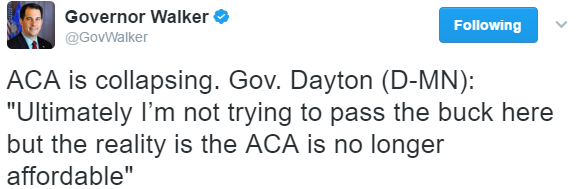
Walker lied about ACA collapse in Minnesota with misleading quote from Gov. Mark Dayton.

Nothing for Scott Walker is exempt from deceptive exploitation. Take this recent tweet:


Wow, that would be breaking news if it wasn't so misleading. Dayton was referring to those on the exchanges who made too much money to qualify for a subsidy. That's not the story Walker wanted you to know, but then what's new? 

Dayton is doing what Walker isn't; he's helping make health care more affordable to higher income Minnesotans because he cares. Walker is not.

I'll try to simply...

Gov. Dayton decided to help those buying insurance on the exchanges who were unfairly paying their full premium, no subsidy. My own brother complained about that last month. Here's the big story that hit the fan in Minnesota, the story Dayton was addressing in the "quote" above:
A Wabasha County Sexton family who is seeing a nearly 40-percent spike in premiums … the Sexton family paid $1,585 a month for insurance coverage. This year, their monthly premium jumped to $2,197. That's a hike of nearly 40 percent. For farm families, the fluctuating prices of milk make paying for increased premiums even tougher.

Gov. Mark Dayton proposed a 25-percent health insurance premium rebate for those who purchased their insurance on the individual market, but don't qualify for federal tax credits. The governor said the plan would help about 125,000 Minnesotans. Thanks to the premium relief the Legislature and the governor authorized in late January, Sheri and Vince will save about $6,600 on their annual premiums this year.
Simply put...
The Governor’s direct relief would reduce average 2017 rate increases from 55 percent to 16 percent for individuals with incomes over $47,520 and families of four with incomes over $97,200, but who did not receive federal tax credits.
It gets even more embarrassing for Walker when you see what Dayton proposed a few weeks later:
In 1992, Gov. Arne Carlson and legislators from both parties created MinnesotaCare — a state-operated health insurance plan. We believe that Minnesotans should have the freedom to buy their health insurance through MinnesotaCare. Their premiums would cover the full cost of their policies, so there would be no ongoing subsidies from the state. The MinnesotaCare "Buy-in Option" would provide a more affordable choice for another 100,000 Minnesotans, who now buy coverage for themselves or their families on the individual market.

Another strong benefit of this proposal, particularly for Minnesotans in rural areas of the state, is the broad networks of physicians and care providers available through MinnesotaCare.
You'll notice Dayton is talking about everyone in Minnesota, INCLUDING rural areas. Dayton is a proactive governor who continues to try and solve problems.

Thursday, January 12, 2017

"We Won" Trump supporter thinks ObamaCare and the ACA aren't the same!!! Part 2

It's an amazing revelation: Republicans thought "ObamaCare" had nothing to do with the ACA - the Affordable Care Act.  I posted a similar story the other day. 

Here's the latest string of Tweets from another Trump voter cluelessly hoping ObamaCare gets repealed (click image for clarity):


Always remember this promise from Traitor Trump as health care in the country as the cost goes through the roof with worthless high deductible junk policies:


Monday, November 14, 2016

Real Health: Big Pharma's Free Speech Rights; GOP opposes saving money on Medicare; Doctors Burning out on Insurance Paperwork-increasing Medical Errors!!!

Freeloading Republicans loves getting a taxpayer check, they just don't like to do anything to earn it. Health care privatization is their way to shift responsibility, so they can shrug their shoulders and say "don't blame us, that's the free market."

Starting with this report, I'll be featuring stories from Modern Healthcare, a great source of news that digs much deeper into the real and more complicated problems of health care than the simple repeal ObamaCare or not distraction. This a subscription service, so some of the links will be inaccessible.

 Republicans Oppose Saving Money on Medicare:
 Multiplesources confirmed that Republicans upset with what they say is overreach by the Center for Medicare and Medicaid Innovation, also known as CMMI … (and) could lead to (Republican) legislation intended to hinder the agency and slow its attempts to further the goal of paying providers for value rather than volume.
Here’s the key point given by Republicans that could easily be applied to their own free market gamble, a bad idea that not one industrialized country is using, and for good reason – it doesn’t work:
More than 170 House Republicans sent a letter to Adminstrator Andy Slavitt in September asking that the CMMI stop requiring mandatory participation in any payment models; “Medicare providers and their patients are blindly being forced into high-risk government-dictated reforms with unknown impacts. Any true medical experiment requires patients' consent. However, patients residing in an affected geographical area will have no choice about their participation.”
1st Amendment gives Big Pharma “Free Speech” rights to Stuff Corporate Pockets? 
The Food and Drug Administration is considering dramatic changes to its drug marketing rules that threaten to make the problem of already out-of-control drug spending even worse … responding to the drug industry's demands for greater freedom to “promote” the off-label use of prescription drugs and to the courts' drift toward giving corporations unlimited freedom-of-speech rights.

“Off-label” refers to uses that have never received approval or scrutiny from the FDA's regulatory scientists (Doctors are allowed to prescribe off-label). The FDA is undertaking its “comprehensive review” now because of a string of recent court decisions saying the First Amendment gives industry sales representatives free rein to promote unproven uses to physicians. The agency may be betting that by weakening its current rules, it will forestall review by a U.S. Supreme Court that is moving rapidly to giving corporations the rights of individuals. But that's the wrong calculus for an agency that's supposed to ensure every drug is safe and efficacious. 
Private Health Care System is Burning Doctors Out of Business, Increasing Medical Errors:
Burnout, defined as physical and emotional exhaustion as a result of prolonged stress, has become shockingly prevalent among U.S. physicians. Doctors experiencing professional burnout not only put their own well-being at risk, but also that of their patients … studies have found that distressed healthcare providers make more mistakes on the job. Surgeons who feel burned out have a higher likelihood of reporting major medical errors, which are estimated to be the third-leading cause of death in the U.S. ahead of stroke and diabetes. Half of surveyed physicians believe that overwork, stress and fatigue among health professionals significantly contribute to medical errors.

In recent years, changes have caused the problem of burnout to worsen. Demographers project the Medicare-eligible population will more than double by 2060. Older people require more care.

A study published in July by the Mayo Clinic Proceedings explored the relationship between clerical tasks, the electronic practice environment and burnout. Doctors who used Electronic Health Records and computerized physician order entry (CPOE) had lower levels of satisfaction because of the amount of time spent on clerical tasks and reported higher rates of burnout. “There are several broad categories of contributors to physician burnout, including greater work hours and effort, poor work efficiency and support, and loss of meaning in work,” said Dr. Colin P. West at the Mayo Clinic, who co-authored the study. “Although the promise of the electronic medical record has been to allow more efficient, higher-quality care, often clerical tasks and electronic medical records negatively affect all of these contributors … leaving less opportunity to interact with patients. In short, we need the technology to support its users rather than the current norm of the users serving the technology.” The extra time required for these routine tasks often crosses the borders of the office into the physician's home, disrupting work-life balance and personal relationships. 

Thursday, November 10, 2016

TrumpCare his first Big Disaster!

Trump's got a big problem when it comes to his promise to lower the cost of health care. Trump supporters actually think he's going to lower prices with better health care:


Here's Trump's never to be forgotten health care promise, and his plan to go with high deductible health savings accounts (HSA):


Trump supporters talked about that promise. Here's just an example:


Lowering the price can't be done unless we go to a single payer system. But even then, while the cost generally would decrease by removing the middleman insurers, we can only slow the rate of medical increases.

I dare the Trump administration to not just match the trend lines in the graphs below showing a decline in the uninsured, but show us a reduction in the actual cost of insurance. He won't be able to do it, and Americans will soon realize they were duped by our con man president.


Trump thinks Health Savings Accounts (HSA) will lower premiums. But they're high deductible insurance policies, which no one can afford, and everyone hates so much on the exchanges. Check out the difference between the deductibles on the ObamaCare exchanges and "off exchange" private insurance policies. It runs counter to Trump's promise:


Remember these graphs and what they represent. Once the Affordable Care Act is repealed, it's never coming back, but premium rates and uninsured Americans will skyrocket. On a human level, preventable deaths with increase dramatically and health based bankruptcy's will be solidly at the top of the list, threatening the solvency of middle-class Americans. Can they take another hit?


Note: Paul Ryan's bogus "patient centered" plan, controlled by insurance companies, is based on people buying "only what they can afford," basically à la carte. In insurance lingo, that's called a junk policy. My conservative friend in Milwaukee is sold on this idea, arguing since he won't have to pay for someone else's vasectomy or pregnancy, he will save money. Care to make a bet insurance companies won't allow their bottom lines to take a hit? It also ignores the fact that no matter what's covered in the junk policy, the cost of treatment isn't any cheaper, so don't expect to save any money.

Example: Before the ACA, my insurance plan had a drug "option," which really wasn't an option at all. I never used it and it cost $500 a year. When I tried to remove it, I was told I could never add it back into the policy. That's choice in the private sector? So this love of the old way of getting insurance is a mystery to me.

Tuesday, October 25, 2016

Health Care Ripoff part 3: ObamaCare premiums increase, thanks to Insurance industry Greed!!!

Ouch, health care insurers are increasing premiums on ObamaCare exchanges by double digits. I guess that would mean the smaller single digit increases weren’t as bad as Republicans said they were.

As I been saying here for years, insurers would eventually find a way to game the marketplaces and poison reform. Paul Ryan knew this when he said ObamaCare would collapse.

In the bad old days before the ACA, premiums increase every year between 20 and 50%. Oh, surprised? A short recap:
In August 2008, about six months before debate began in Washington on what would become the Affordable Care Act, 82 percent of Americans were so dissatisfied with the U.S. health care system they wanted it overhauled.

The main reason so many of us were uninsured in 2010 was that health insurance had simply become a budget-buster for many American families. The cost of employer-sponsored family coverage reached $13,375 in 2009, an increase of 131 percent in ten years, according to the Kaiser Family Foundation.
 
And almost 18 percent of our GDP is consumed by health care expenses, compared to 11.7 percent in France and 11.3 percent in Germany.  
Under Bush, the average family premiums (including both what employers and employees pay) went up $4,677 in his last six years in office, from 2002 to 2008, an increase of 58 percent. Bush’s first six years that increase was 72 percent.
Note: think what would happen in a GOP free market system replaced the ACA, with no plan requirements and no marketplace to compare prices. Do you think prices would increase dramatically even with supposed “affordable,” “buy what you can afford” junk policies? God would they.

Insurance companies want more Money....and are in a full court press to pressure the government to give them more money to boost profits. It worked before, with Medicare Advantage, why not ObamaCare. Briefly, let’s go back 16 years, with former insurance exec. Wendell Potter:
HISTORY (OF HEALTH CARRIER GREED) REPEATS ITSELF-Profit-Minded

 
Health Insurers Will Likely Return to Obamacare Fold in 2017: 16 years and five months ago, after the close of trading at the New York Stock Exchange, my staff and I at Cigna disseminated a press release we knew would lead to a lot of angst in Washington, on Wall Street and around the country. Cigna to Curb Medicare-HMO Risk; This was the headline in the company’s hometown newspaper, the Philadelphia Inquirer: Cigna to Exit 13 Medicare Markets … 104,000 of Cigna’s senior-citizen subscribers were being dumped because the company wasn’t happy with how much the government was paying it to provide access to medical care for those folks.
Guess who instigated the Cigna scheme? The Republican inspired Balanced Budget Act in 1997:
Insurers had been unhappy with their pay from Uncle Sam since the passage of the Balanced Budget Act of 1997, when Republicans were in charge of both the House and Senate. The GOP wanted to rein in spending on “entitlement” programs ... It reduced Medicare spending by more than $100 billion between 1998 and 2002 … capped annual reimbursement increases 2 percent on average...(but) medical inflation was averaging 8 percent annually. The companies clearly were not managing medical costs nearly as much as they had told lawmakers and their customers they would be able to do. So Cigna, at least, had decided to cut bait.

Fast forward to August 15, 2016 and the era of Obamacare. That was the day Bloomberg ran this angst-producing headline: Aetna to Quit Most Obamacare Markets, Joining Major Insurers. Why? Because, once again, the big insurers were not only not making the profit margins they felt they should be making, they were losing money on this particular book of business. So, just like they did a decade and a half ago, they decided to cut those enrollees loose.

And they were spectacularly successful back in the early 2000s. In short order, there was a reversal in fortune — in the insurers’ favor. So if the past is prologue, we can expect the insurance industry’s lobbyists to be hard at work to make sure history repeats itself. 


Keep in mind that the insurers’ Medicare + Choice losses were an unintended consequence of the Balanced Budget Act of 1997. Republicans in particular were alarmed when the insurers began abandoning the Medicare HMO market because it has long been a tenet of faith among many of them that private insurers could operate more efficiently than the traditional Medicare (TM) program, and consequently reduce overall spending on Medicare.
As you can see, this isn't an easy industry scam to explain. Here's more....
Congress Showed Health Carriers the Money: So halfway into the George W. Bush administration, with Republicans still in charge of both the House and Senate, the Medicare Prescription Drug, Improvement and Modernization Act of 2003 became law. The insurance industry’s lobbyists scored two big victories ... the prescription drug benefit (known as Part D) made it necessary for Medicare beneficiaries to buy their drug coverage through private insurers. And second, the Medicare + Choice program was overhauled to the industry’s liking (and renamed Medicare Advantage).

The government began paying private insurers more to cover the cost of sicker Medicare enrollees, so the companies that had bailed came rushing back in. There were also other provisions of the 2003 law that boosted the government’s pay to insurers. As a consequence, by the time Obamacare became law in 2010, the government was actually paying Medicare Advantage plans 14 percent more per beneficiary ($1,100 on average) than it would cost to cover those beneficiaries in traditional Medicare. Between 2004 and 2008, the overpayments totaled almost $44 billion.

One of the aims of Obamacare was to reduce those overpayments, and they have been reduced, but most insurers are still finding their Medicare Advantage business to be very profitable. You certainly don’t hear about insurers threatening to jump ship now.

You can also expect the insurers to lobby for more “flexibility” in designing their policies. They’d love to be able to go back to the days when they could sell junk insurance — policies with such meager benefits they rarely had to pay out much in claims.

Monday, September 26, 2016

ObamaCare Exchanges not a job killer, and Americans auto enroll instead of forcing insurance companies to compete, resulting in higher prices.

It looks like Americans don't have enough time in their busy lives to shop for health insurance. It's crazy really, going through the ritual of picking the least draconian plan year after year, just to save lots of money. Too much work.

Nothing could be easier than going online and comparison shop for insurance. But that's not happening, resulting in higher prices for those seeking insurance.

Here are two important ObamaCare facts recently revealed by the Kaiser Family Foundation:
1. Obamacare was not a job killer: One of the more prevalent concerns surrounding Obamacare's implementation of the employer mandate -- the actionable component of Obamacare that requires employers to offer health coverage options if they have 50 or more full-time equivalent employees (FTE) -- was that it would coerce employers to reduce full-time employees to part-time, or it would result in job cuts.

Since Obamacare was officially launched, 7% of employers with 50 or more FTE bumped part-time workers up to full-time compared to just 2% of employers who cut full-time workers to part-time. 
2. Competition among insurers is a genuine issue: For starters, competition among insurers is actually declining. 

The other issue is that we're not seeing consumers necessarily making informed purchasing decisions with the information afforded to them. In each of the past two years millions of Americans have auto-enrolled in their previous year's plan, which is a potentially terrible idea. Plan coverage options and premiums change each year, and what may have been the best value one year may not be the next. What this essentially demonstrates is that the consumer isn't taking the time to shop around, which is further putting pricing power back into the hands of insurers. 


Wednesday, September 21, 2016

"Temporary" end to ObamaCare offered up by Dumb Ron Johnson...gee, thanks?

Dumb Ron Johnson must think we're dumb too.

In what appears to be a "we're not kidding" effort by Republicans reacting to reduced ACA Marketplace insurer participation, their plan is to completely dismantle ObamaCare...I mean introduce competitors not on the exchanges.

I just had to shred this one. Lets take a look at the State Flexibility to Provide Affordable Health Options Act...
STATE COULD ALLOW WISCONSINITES RECEIVING SUBSIDIES TO BUY INDIVIDUAL INSURANCE POLICIES NOT OFFERED ON OBAMACARE EXCHANGES, WITH NO PENALTY ON INDIVIDUALS WHO CANNOT FIND A GOOD PLAN.
Let's see, reward taxpayer subsidies to insurance companies who decided not to be on the exchanges, offering fewer health services for the same price, but also allow people to go without any coverage at all. Wow, that sounds like a world without ObamaCare.

Maybe I've got something wrong...one more time...

  • Give states with a failing Obamacare exchange the authority to allow residents to use their Obamacare subsidy to purchase any health plan of their choice, even those off the exchange, for the 2017 plan year.
  • If the state chooses to use this authority to allow residents to use subsidies outside of the exchange, the legislation will waive the Obamacare law’s requirement that you must buy a specific health care plan or pay a fine of as much as $2,000 for a family of four next year. 
But wait, wouldn't that drain the exchanges and hurt insurers, collapsing the whole ACA while increasing the uninsured and filling emergency rooms with unreimbursed health care?

That's our Dumb Ron Johnson.
A summary of the State Flexibility to Provide Affordable Health Options Act is available online HERE

Health Care Costs Increase, but not because of the Affordable Care Act!

Even during the run-up to the Affordable Care Act, the media and health care pundits never brought up the deplorable state of our private insurance based system.

I remember it well as a small business owner because I had to shop in the individual market every year after receiving huge premium increases to re-up. While the media claimed increases somewhere around 10%, mine were 20 to 30%. Looks like I was right. LA Times:
Family premiums have increased 20% over the last five years, which is a lot but a darn sight better than the 31% hike over the previous five years, and a huge improvement over the staggering 63% growth in the five years before that.
A look at the latest stats will probably prompt Republicans to blame ObamaCare for increased health care costs, but that would be a lie. Here's the headline:
Sick: The biggest increase in healthcare costs in 32 years: The U.S. Labor Department reported Friday that spending on healthcare rose last month by the biggest amount (1%) in more than three decades.
But it’s wasn't ObamaCare's fault, or even insurance companies jacking up premiums; blame hospital costs and drug prices. This is very important to understand;
The overall price of medical treatment increased by 1% in August … the largest monthly gain since 1984 … The cost of hospital services climbed 1.7% in August, the biggest gain since October 2015, while the average price of prescription meds jumped 1.3%. That means average drug prices are up 6.3% over the last 12 months, the largest such increase in two years.
Health care is NOT a Consumer Product: The most egregious mistake Republicans like Paul Ryan make is treating health care like a consumable product. We don't "shop" for care, but receive it when we are least able to do anything but get immediate medical help.

Ghoulish Health Care Profits: Republicans must think buying health insurance makes this a consumer product, but ridiculous. In other industrialized countries, there are strict laws barring anyone from profiting off of the sick and dying. Makes sense, right? And that should be a dilemma for Republicans, but isn't because...
This country already spends $3 trillion annually on healthcare. That represents about 17% of total economic activity. The average for all nations within the Organization for Economic Cooperation and Development is 9%.

It’s deeply worrying that one of our most robust and reliable engines of economic growth is the business of sick people. Unless, that is, having the biggest hospital and drugstore bills is a point of pride.
It's a nasty revelation that I hope a few conservatives might start thinking about.

The other big topic I’ve been shouting about for years; Workplace Employee Deductibles and Health Savings Accounts, a Republican idea that brings about self rationing and bankruptcy so sick people have "skin in the game," like they don't already have a lot to lose:
Many Americans are paying more out of pocket for healthcare as they try to keep a lid on monthly premiums by accepting higher insurance deductibles … annual family premiums for employer-sponsored health plans are up an average 3% to $18,142 ... high-deductible plans shifting a greater share of the spending burden to patients … insurers keeping costs down by providing less-comprehensive coverage. Twenty-nine percent of all U.S. workers are now in high-deductible plans, up from 20% two years ago, according to Kaiser.
And what about drug prices?
A recent report from the Government Accountability Office found that while the average price of generics has come down in recent years, more than 300 generic meds have experienced “at least one extraordinary price increase of 100% or more.” Investigators found 15 generic meds that have seen price hikes of more than 1,000%.

Monday, August 15, 2016

Trump Trolls: Defending insurance companies and telling people with preexisting conditions, it's your problem!!!

There's a reason there are so many stories predicting the end of the Affordable Care Act's exchanges. But the real story is not getting media coverage; insurers simply found out they can't compete with each other by lowering their prices, the underlying free market idea that would make Paul Ryan's supposed "patient centered" reform so successful.

So over the weekend, I responded to the story below with a few comments of my own:
Taxpayers on the Hook as Obamacare Exchanges Near the Edge of Collapse: UnitedHealth is pulling out completely, Humana is pulling out of 88 percent of counties it was in, and last weak Aetna strongly suggested it will be exiting, too, unless it gets bribed to stay with a huge, annual infusion of direct corporate bailout payments from taxpayers. Obamacare supporters need to be held accountable for the law’s manifest failures – not permitted to paper them over with billions more of our tax dollars.
Of the two rightwing rants, the last response pretty much encapsulates the survivalist world view of conservative voters everywhere. It's been that one thing that divides us on health care; do we save people or let them die. It's enough to give you a chill:

No one’s talking about the elephant in the room: Insurers are dropping out because they're losing money competing, lowering their prices to gain customers. The marketplaces simply proved insurers can't survive by competing and dropping the sick to boost their bottom lines. Now what, junk policies under the Republican plan that covers fewer medical issues and includes small print exclusions? Yup.

The liberal is pulling out the 'pity, pity, pity' statements and complaining about the 'evil insurance companies'. Same worthless emotional arguments those snivelers always have.
These sniveling liberals could still (plenty of rich ones!) start their own insurance company or mutual company or something to provide health insurance at a ‘‘fair’’ price. Wow, without the obscene profits, they could compete in the open market at a very low price. Obviously, besides serving themselves, they could take all sorts of current customers away from the bad, evil, big insurance companies.
That is, of course, if the liberals are capable of taking real action. Maybe they are only good at whining, sniveling, and wanting their Mommy (government) to fix everything for them.

Who covers and pays for those with preexisting conditions...oops, forgot to think past your ideology.

That's the problem of the person with the pre-existing condition, not some insurance company that you're trying to force to pay for something that's not their responsibility. And the only insurance company that should be covering a pre-existing condition is the insurance company that the person was with BEFORE the condition existed, since for them, it wasn't a pre-existing condition. And if you didn't have insurance before the condition existed, then it's your own responsibility to pay for it, no one else's. This is the problem with you libs. You're always trying to get someone else to pay for things that are YOUR responsibility to pay for. You're all OPM addicts, as in OPM = Other People's Money!!!

Didn't need to "think past" anything on that. The answer was self-evident.

Tuesday, August 9, 2016

Louisianians rush to stay healthy...go figure.

It always seemed odd to me when I heard Republicans complain about people using expanded Medicaid coverage in their states. Ah, that’s what it was supposed to do?

It also seemed odd to hear conservatives say “I told you so” when the media reports that people are seeing their doctors more often, supposedly over using their Medicaid services. Ah, maybe they were literally dying to see a doctor, or get treatment, or get a prescription? Just saying.

The Boston Globe featured this article today that explains just how important health care is to Americans everywhere, and to our economy in general. Louisiana is an incredible example of what a Democratic governor, doing Democratic things, can do:  
Louisiana voters elected John Bel Edwards governor (the only Democrat governor in the Deep South). Edwards noted that Louisiana “consistently ranked one of the poorest and unhealthiest states.  (Access to Medicaid) will not only afford them peace of mind, but also to help prevent them from slipping further into poverty and give them a fighting chance for a better life.”
Here's a list of facts you can use against your right-wing friends:
1. Edwards’s predecessor, Bobby Jindal, rejected the measure on the grounds – and I’m not making this up – that expanding access would “jeopardize the care of the most vulnerable in our society.”

2. The impact of Edwards’s executive order is being felt across the state. The law is having a transformative effect … “Patients burst into tears at this city’s glistening new charity hospital when they learned they could get Medicaid health insurance,” Noam Levey reported. One doctor said telling patients that they were eligible for health care coverage – something most of us take for granted — was like telling them, “I cured cancer.” Residents who had held off getting prescriptions filled or postponed screenings or seeing a doctor are now able to do so with Medicaid coverage.

3. Since Pennsylvania passed its Medicaid expansion, nearly 10 percent of the more than 650,000 who enrolled in the program began drug and alcohol abuse treatment – that’s approximately 65,000 people with an opportunity they didn’t have before to end their addictions.

4. According to one study … the expansion in Arkansas and Kentucky (and non-expansion in Texas), “poor adults” had more access to care and “skipping medications because of cost and trouble paying medical bills declined significantly.” Moreover, the “share of individuals with chronic conditions who obtained regular care increased” and the percentage of residents who were able to simply have a medical checkup jumped by 7 points. In Texas, where expansion has not taken place, there’s been little success in reducing uninsured rates or improving health care outcomes.

5. This is a great public policy story — one that shows how a targeted effort using government resourcesfor the most vulnerable can produce positive, even life-changing results. 

6. Gov. Terry McAuliffe expanded Medicaid for more than 400,000 Virginians. Bogus claims that it would cost the state $1 billion … The actual cost as estimated by the fact-checking site, PolitiFact, is around $3 million.

7. According to the Kaiser Family Foundation, approximately 3 million more Americans would receive access to care if Medicaid expansion occurred in every state. That’s 3 million Americans who can’t see a doctor or a dentist, can’t fill prescriptions, and can’t get the drug or alcohol treatment that could turn their lives around.
Republicans, who's moto is “party first above country,” oppose health care because it’s to successful, and a Democratic Party idea:
Continued GOP opposition (is) a refusal to support anything that has the name Obama on it. Expanding Medicaid would mean that Republicans implicitly acknowledge that Obamacare has some positive elements to it — and risk the political fallout from Republican voters. For the modern GOP, that’s a bridge too far.
But in the 19 GOP-controlled states … a different choice is being made: to put political preservation and hatred of President Obama above the needs of their citizens. Not surprisingly, these states are among the unhealthiest in the nation, with some of the highest rates of illnesses and deaths from diseases that are often easily preventable.

There might not be a bigger and more shameful political story in America today than this one. And there also might not be a better example of the fundamental divide that separates America’s two political parties.

Wednesday, June 22, 2016

ObamaCare saving $2.6 Trillion through 2020 while Republicans roll out "new"detail free plan to increase insurer profits.

It's a good news/bad news kind of week for the Republicans; the bad news, at least for them, was the $2.6 trillion projected reduction in health care spending due to the Affordable Care Act. 
Projections of U.S. healthcare spending growth have come sharply down since Obamacare’s enactment in 2010 ... $2.6 trillion lower than the original post-ACA baseline forecast through 2020, a reduction in projected spending of almost 13%. This is known as “bending the cost curve”: Americans will be spending more in 2020 than they are now, but the rate of increase looks to be significantly slower than anyone expected. The study attributes much of the change, albeit an indeterminate portion, to the ACA. 

It’s true that growth in overall healthcare spending ticked up during 2014, reaching 6.2%  ... officials say that by the last quarter of 2015, spending growth had dipped back below 5%. If that’s so, the Urban Institute report says, “spending projections will continue to fall and it will become harder not to attribute at least some of the sustained cost containment to the ACA.”
As bad as that news was for Republicans, they did have some good news; Americans will finally get to see their long awaited "patient centered/free market" health care replacement plan for ObamaCare, something I’ve reviewed here in a previous post. In summary:
A series of familiar conservative healthcare ideas … The 37-page plan was originally billed as part of a comprehensive governing blueprint…
...Paul Ryan’s latest “comprehensive...blueprint" of the same old reform con, again, prevents the CBO from grading it:
…missing key details and legislative language that would allow independent analysts such as the Congressional Budget Office to assess its cost and impact.
Ignoring the natural aging process and diminished mental capabilities of seniors, Ryan wants them to shop till they literally drop:
…replace the current government-run Medicare benefit with a system of vouchers,“premium support," that seniors could use to offset at least part of the cost of premiums for private health plans.” 
Ryan's supposed "free market" plan oddly takes all the risk out of that marketplace with state high-risk pools, so insurers can make a profit from just healthy Americans:
Ryan himself has advocated turning over coverage for preexisting conditions to state-sponsored high-risk pools. As we’ve reported, this is a scam: high-risk pools have been tried before, and they almost always become ruinously expensive and doomed to fail.
Ryan also wants to allow states to cut health services, adding hoops and blockades for those who truly need care:
…eliminate federal rules that establish who should be covered, such as poor children and pregnant women, and which benefits should be offered. Each state would be allowed to decide who would get coverage.
Just one last chart supporting the ACA reforms:


Monday, May 30, 2016

Competition on ObamaCare exchanges worked!!! Lowered premiums!!! Now Insures want Out Due to Lower Profits!!!

Republicans think you forgot how our old health care system, before “ObamaCare,” failed miserably.

Who the hell is nostalgic for the days when insurers dropped people with pre-existing conditions, jacked premiums and deductibles up to unaffordable levels, and allowed insurers who cherry pick the healthiest Americans?

Since when do we rank health care by how much insurers make?

Hello, treating the sick and dying…remember that?

Now see how Forbe’s packages the Affordable Care Act as a failure because it cut insurance company profits, while saving you and me money. It should be a shock to your sense of humanity:
The story is similar for other insurers. Many have decided to abandon markets they have long served. That’s left people fewer options for coverage. And with less competition on the exchanges, the plans that remain have more freedom to hike premiums. Obamacare’s ongoing dysfunction is bad enough. But the looming collapse of its exchanges is prompting calls for even more government involvement in health care — even a single-payer system.
Competition Worked, Lowered Prices - now Insurers Want Out: Flipping market competition on its head, suddenly lower prices are bad...for them? Think about that; competition made insurers cut their premiums, which is now making them drop out of the exchange. If anything, the ObamaCare exchanges worked too well.

Forbe’s also wants you to think the ACA is “government” health care, when in fact it’s just a mall for private insurers:
It takes a special kind of reasoning to respond to the spectacular failure of government that is Obamacare by calling for, well, even more government.
Their Loss is Our Gain: Think of the next statement as money we saved shopping on the exchanges, and not money insurers “lost.”
Health insurance companies lost as much as 11 percent on their exchange plans last year. That’s more than double the amount they lost during the exchanges’ first year.
The following anti-competition group of insurers is part of a rogue’s gallery of blood thirsty profiteers, salivating for a Paul Ryan style plan of junk policies offering a la carte services (what you can afford) and loop holes you could drive a Mack truck through (small print legalese):
Insurers have responded by heading for the exits. UnitedHealth will now only sell health plans in three states. Humana abandoned several markets after posting a 46 percent drop in earnings. Premera Blue Cross will leave Oregon and a dozen counties in Washington State.
Want competition to work, stay away from these ghouls.

Promise? Not Quite: My own brother is pretty well off and told me how angry he was that he didn't at least get some kind of deal under the exchanges. I agreed, upper middle class folks should get something, but it wasn't like he'd go broke paying his own way. I know for a fact he would never go without coverage. Which brings me to the articles final statement.
These subsidies don’t apply to millions of middle-class people. To afford premiums, many must cut other parts of their household budget — or go uninsured.

The Obama administration promised that this wouldn’t happen. The White House said that Obamacare would “curb excessive premium growth for . . . millions of Americans.” It said that ... creating online exchanges would yield a marketplace where insurers competed on price and quality. But many Americans have not benefited. One in two disapproves of the law.
"...creating online exchanges would yield a marketplace where insurers competed on price and quality" and it worked, lowering prices and hurting insurance company profits. Cry me a river.

Monday, May 9, 2016

Walker out to prove rising health care Obama's fault, not the insurers jacked up prices.

Scott Walker’s plan to raise health care insurance prices in Wisconsin is working. Why would he do that? To pour more money into for profit insurers pockets, and to make “ObamaCare” look like a failure. 

The fact is, the outrageous cost for medical services by three of the biggest insurers in the state raised everyone's premium.

And don't forget about the state insurance commissions hands off approach to premium increases on the exchange. Walker voters, I'm guessing, don't mind handing their property tax savings over to the insurance industry, as long as it supports a very costly "free market" system. JS-Guy Boulton:
Claims data for three of the country's largest health insurers, (UnitedHealthcare, Humana and Aetna) including two of the largest in southeastern Wisconsin, rank the state as having the second-highest medical prices in the country, behind only Alaska.
A study by the Health Care Cost Institute, a nonprofit organization created to make claims data from health insurers available to researchers, found that prices for 235 common medical services grouped as "care bundles," ranging from basic tests to back surgery, were on average 81% higher in Wisconsin than the national average.
The supposed "best health care system in the world," still inaccessible to millions of Americans, continues to pick our pockets...because they can in the private sector. After checking out the stat below, you have to wonder why every Republican continues to make the false claim that moving to a single payer system won't save money:
The United States spends 50% more on health care than any other developed country — an average of $9,523 a person, or $38,092 for a family of four in 2014. And health insurance is expensive because health care is expensive.
The corporate response from the health care lobbyists in the state was laughable, if not a tad bit insulting. They claimed the report wasn't fair because the 3 biggest insurers weren't major players in other parts of the state, so...?
"The fact that the three insurers that provided data to the HCCI are not major players in most markets around the state makes this study misleading to readers, and largely irrelevant in Wisconsin," Brian Potter, senior vice president of the Wisconsin Hospital Association, said in a statement.

But UnitedHealthcare had 54% of the Milwaukee market, 49% of the Green Bay market and 37% of the Appleton market in 2013, according to a study by the American Medical Association.
The states industry lobbyist are telling us the same thing they said after the GAO released their study last year. Will we ever really know if we're paying too much in Wisconsin? No. Are we really that happy about cost of health care costs? We must be:
The same contention — that the claims database is not representative of the state — also was raised about a study by the Government Accountability Office released last year that found that Milwaukee and Madison were among the seven most expensive metropolitan areas in the country for three common procedures.

Further, even if the claims data used in the recent study by the Health Care Cost Institute is not representative of prices in some markets, UnitedHealthcare, Humana and Aetna still are paying the prices — and those prices are much higher than the national average.
Here's the sad truth about treating health care like a consumer product, like a market product:
If nothing else, the wide variation in prices strongly suggests a market that isn't working like other markets.

Government health programs, such as Medicare and Medicaid, set the prices they will pay.
The Republican argument against the Affordable Care Act has been successful because most people know little about it, and because they get coverage through their employer, which shields them from the actual cost:
But the U.S. health care system relies on the market to set prices paid by commercial health plans. It is a market in which the cost is largely hidden from the consumer — the patient — because medical bills are paid by health insurers and employers once someone hits his or her deductible and maximum out-of-pocket expenses. The result is that most patients are indifferent to the cost. 
And having gone through a futile attempt myself to get a hospital to tell me the actual price of their treatment, because prices vary depending on what insurer their working with (add to that a different price for cash), this might be the best argument against a market based system:
Getting information on prices also can be difficult. Even when insurers make prices available to the people in their health plans, few make use of the information.
When you're sick, injured or unconscious, how can anyone make the kind of choices necessary for the healthiest outcome? Who wants to burden relatives, even if you're lucky enough to have a few? The article wrapped up with this:
Employers have been reluctant to embrace health plans designed to encourage people to get care from doctors and hospitals that provide quality care at a lower cost.

For instance, few employers have moved to health plans based on so-called reference pricing or on tiers. A health plan based on reference pricing pays a set amount for certain medical services, ranging from MRIs to colonoscopies to back surgeries. People still are free to get care from anyone in a network. But they must pay the cost above the reference price.

Health plans tied to tiered networks give people an incentive, such as waiving the deductible, when they get care from hospitals and doctors that provide quality care at a lower cost. "Now the question is how do we fix health care. We know it is too expensive."
Having had cataract removal, the chart below is even more interesting to me. The U.S. average represents what I paid directly to the doctor and surgery center, bypassing my insurer and the $7,000 deductible. Yes, it was cheaper to pay directly than use the deductible and insurer. So is the the free market insurance model bad. Yes, and that's where Republicans want to take us: