Showing posts with label Scott Walker Jobs Promise. Show all posts

Friday, February 22, 2019

On Job Growth, Tax Cuts and Protecting Dairy Farms, Walker's Legacy an Astonishing Failure!

Scott Walker's smoke and mirrors legacy is really starting to crumble, even as Republican legislators brag about how great the last 8 years have been. Oops?

Let's note just how bad things after Walker replaced reality based problems crying out for solutions with right wing theoretical concepts that ignored everything.

Keep in mind, this is just two months into Gov. Evers first term. Republican Rep. Robin Vos repeated Walker's ridiculous sales pitch, even as the following facts contradicted every word:
Vos: "Our state and its people are thriving. Wisconsin now has more jobs than people to fill them. It’s clear: the state of our state is strong. You might ask, how did we get here? For the last eight years, Republicans worked hard to make Wisconsin open for business. We cut taxes by more than $8 billion."
1. Walker thought Tax Cuts created Jobs...Wrong: The numbers just came out, and they're not helping Vos' argument one bit. For a complete breakdown see Jake's Wisconsin Funhouse:


Try attracting out of state workers with wages 20% lower than surrounding states. Looks like that ad campaign is just another waste of taxpayer dollars.

Tax Cuts = 30 Percent Fewer Jobs, Poverty Rates Higher, Lower Participation Rates: A study from July 14, 2017, from a researcher who calls Wisconsin his home state...:
WPT: Wisconsin Tax Cuts Did More Harm Than Good, Study Finds: A new study coauthored by Oklahoma State University Economics Prof. Dan Rickman found recent tax cuts actually hurt Wisconsin. The study, which compared Kansas to Wisconsin, found that 30 percent more jobs could have been created from 2011 to 2015 if it were not for tax cuts. The study also found that the unemployment and poverty rate would have been lower, and labor participation would be higher.


Scott Walker Legacy; he Ignored and Destroyed Dairy Farms: Walker's 8 year focus was to replace our current structure of government with a theoretical conservative system that shockingly ignored solving problems; youth prisons, veterans homes, polluted drinking water, underfunded state parks, deteriorating roads, financially squeezed schools, mass transit, CWD, etc. and...

...the one things that put Wisconsin on the map; America's Dairyland. Instead of understanding the problem and leading a reform movement to save our states dairy farms, heck the whole industry, he instinctively thought of mega corporate farmers and producing an oversupply milk. That resulted in low prices for the last 4 years:
In 2012, Wisconsin Gov. Scott Walker announced an incentive program to produce, as a state, 30 billion pounds of milk a year by 2020 a 15 percent increase

Despite record production every year since 2002, Walker urged farmers to step it up even more.

Dairy farmers ... reached 30 billion pounds in 2016 — four years ahead of schedule. By then, however, the market had turned and many dairy farmers were having trouble breaking even on their new investments. Some felt duped by the agribusiness system.

The more surplus farmers produce, the lower the price of agricultural commodities for food processors," said Kara O'Connor, government relations director for the Wisconsin Farmers Union.
Who did Walker help most? Guess...
"All of the most powerful players in the industry, except the farmer, benefit from overproduction."
Notice how Walker's program alone brought down the dairy industry in the chart below:


Walker left another major problem for the Democrats to solve:
1. By the turn of the 20th century, 90 percent of Wisconsin farms had dairy cows, and led the nation in butter and cheese production ... until 1993 when that recognition went to California.


2. For nearly 80 years, “America’s Dairyland” has been imprinted on the state’s license plates.

3. Dairy contributes more to Wisconsin’s economy than citrus does to Florida or potatoes to Idaho, and more than a quarter of the nation’s cheese comes out of the state.
But then the problem festered under Walker and his bad policy advice, along with Trump's tariffs:
4. Wisconsin lost almost 700 dairy farms in 2018, an unprecedented rate of nearly two a day.

5. As of Feb. 1, Wisconsin had 8,046 dairy herds, down 40 percent from 10 years earlier, according to state Department of Agriculture data. 

6. Remaining dairy farmers have burned through their farm equity and credit to remain in business. 

7. Although consumption increased, they've not always kept pace with runaway production.  

8. Foreign markets for American dairy products have shrunk in response to tariffs that President Donald Trump placed on foreign steel and aluminum. Cheese shipments to China have fallen almost 65 percent, according to industry figures, and exports to Mexico are down more than 10 percent. 

9. Laurie Fischer, CEO of the American Dairy Coalition (said) “The administration has not lifted steel and aluminum tariffs on Mexican and Canadian products, and in response, those countries are refusing to (ratify) the pact or lift retaliatory tariffs, impacting dairy products and other items."

And Trump's supposed farm "bailout? Horrific:
10. A 55-cow dairy farm would receive a one-time payment of $725 from the bailout but stood to lose between $36,000 and $48,000 in income last year from low milk prices, according to the Wisconsin Farmers Union. A 290-cow dairy would get $4,905 but would lose several hundred thousand dollars. 

11. Farmers have flushed milk down the barn drain because they couldn't find a processing plant to take it. 

12. Some farmers have shot calves because the newborn animals had no market value and were considered too expensive to raise for beef. 

13. The stress farmers have endured in trying to keep everything together has been overwhelming, especially on farms passed down for generations. Nobody wants to be the one to close the gates. Elizabeth Rich, an attorney from Plymouth and president of the Farm-to-Consumer Legal Defense Fund Foundation said, “Fifth- and sixth-generation dairy farmers are losing their farms; many are killing themselves. We can and must do better.”

14. Some farmers say the U.S. needs a milk supply management system, like Canada has, that imposes production quotas and protects farmers' income. Critics of Canada's system say it has resulted in trade barriers to U.S. dairy products. "But whether the answer is a system similar to Canada's supply management program or something completely different, we can't just sit back and continue down the same current path without trying to find something that actually works for farmers," Brad Rach, dairy director for the National Farmers Organization, wrote in a blog.  

Saturday, October 20, 2018

Walker's Failed 250K Jobs Promise someone else's fault?

It's Scott Walker's career politician scam; blame someone else. Check out WSJ article:

Jadin said he told the governor it was foolish to blame an agency the governor had created to carry out his pledge and at the time led as board chairman, but Walker, Jadin recalled, didn’t respond to that concern.

The job Jadin accepted that day was as president of Thrive, now known as the Madison Region Economic Partnership. On Wednesday, Jadin resigned that $208,000-a-year job in order, he said, to speak publicly about Walker.

Monday, December 4, 2017

Walker targets workers in Chicago and elsewhere, bypassing hard hit Milwaukee, Racine and rest of State.

Scott Walker has washed his hands of every out of work Wisconsinite, giving up on them (too much work I guess) while seeking an outside labor force from Illinois. Wow, what an idea; take the easy way out after trashing public education, without ever lifting a figure to train, retrain, or coordinate employers with schools to encourage apprenticeship programs statewide. Oh, and with low unemployment, we're going to need an Illinois Foxconn workforce that bypasses the struggling Milwaukee/Racine jobless. 
Gov. Scott Walker’s announcement of a $6.8 million marketing and advertising campaign aimed at Midwestern millennials, returning military veterans and alumni of the state’s public and private colleges … promote the state’s industry mix, recreation, education, arts, health care.
Walker has had only one agenda; push a manufacturing renaissance and not an “industry mix.” Just as bad, he's defunded state parks and deregulated hunting (“recreation”), cut “education” especially the “arts,” and opposes a right to “health care.”

Big Corporate Special Interest Panics Walker: Oops, it'll be interesting to see how Walker spins his concentrated jobs effort in southeastern Wisconsin to all those resentful "forgotten" rural Republican voters who appear to have drawn the short straw again:
"Walker says German candy-maker Haribo was concerned about its ability to find workers for its planned Wisconsin gummy bear factory that will employ 400 people in Pleasant Prairie after news broke that Foxconn Technology Group was building a massive facility nearby. Walker met with company officials to calm their fears. Foxconn plans to employ between 3,000 and 13,000 workers 13 miles away in Mount Pleasant."
"Cheesy Image of State Needs an Update?" In the paper edition of the Wisconsin State Journal, this brutally honest headline (changed and softened online) exposes the Republicans unabashedly elitist view that the states major nationally known industries are an embarrassment that we need to run from:


Remember, our corporate whiny elitist snobs want to change our state license plate logo from Americas Dairyland to something generic or perhaps Walker's latest tourist roadside attraction:


After changing the online headline from an insult to "Fighting misperceptions about Wisconsin in the hunt for workers," right-wing business columnist and "wordsmith" Tom Still failed miserably to frame the GOP's distaste for Wisconsin image of cheese and farmers. Sounding whiny, petty and outright elitist...:  
It’s no secret that Wisconsin is a secret when it comes to most things other than cheese, farms and the Green Bay Packers. That branding dilemma…Job diversity means choosing between careers in curds, Colby or Cheddar.

The combination of a looming worker deficit and the impending arrival of high-tech manufacturers such as Foxconn has created a moment in which Wisconsin must finally get serious about attracting more people and selling itself as a well-rounded place to live, work and play.

Wisconsinites Moving Out: Never mind that Republicans have trashed the liberal out-of-touch science tech jobs leader Dane County and those elitist tech researchers at the University of Wisconsin. With no increase in the minimum wage and right-to-make-less labor laws...
WSJ: Despite a new report showing Wisconsin has the fastest-shrinking middle class in the U.S., the Gov. Scott Walker administration says the state is headed in the right direction.

March 24, 2015: Wisconsin ranks worst among the 50 states in terms of a shrinking middle class, with real median household incomes here falling 14.7 percent since 2000, according to a new report. The Pew Charitable Trust report showed Wisconsin with the largest decline in the percentage of families considered "middle class."

A declining population, particularly when residents are moving out of state, often can be traced to a lack of job opportunities or a low quality of life. Between 2010 and 2015, 14,210 more people moved out of the state than moved in, equivalent to a net population loss of 0.2% over that time. Wisconsin is one of just 14 states with a net negative migration over the last five years.
Even more incredible, after Walker just appeared in a campaign ad supporting Ill. Gov. Rauner's reelection effort, our backstabbing governor is begging Chicagoans to move to Wisconsin. No really, this is nuts: 
Reach out to Millennials in Chicago and nearby on the theory that they’re reaching an age in which starting a family and leading a more balanced life is better than living in a tiny apartment and fighting rush-hour traffic. 

For example, multimedia ads would pose illustrated choices such as:
1. “An hour in traffic … or an hour with friends?”

2. “One-hour commute … or one-hour bike ride?” (MY GOD, Walker passed a "provision that prohibits local jurisdictions and the state DOT from condemning property to 'establish or extend' recreational trails, bicycle commuter paths, bike lanes or sidewalks.")

3. “Shoebox on the third floor … or loft in the Third Ward?”
Of course, Tom Still couldn't help but bash the state's reputation one more time, while ignoring Walker's admitted "divide and conquer" agenda where he once praised the statewide partisan anger pitting neighbor against neighbor as a healthy debate:
A point yet to be addressed is how to overcome a belief, which surfaced in the 2015 perception survey, that Wisconsin isn’t very tolerant. Part of persuading people to relocate is assuring them they won’t become strangers in a new land ... maybe this time the state will recognize it must cut a big block of cheese if it hopes to attract and retain tomorrow’s workers.

Wednesday, September 13, 2017

Walker's desperate 15 year grab for 3,000 jobs and forced budget cuts to get reelected.

Funny thing about the Foxconn debacle to attract only 3,000 jobs, is the underlying problem. A labor shortage and low unemployment.


Wisconsin's 3.2 percent unemployment rate in July is near a record low That's well below what economists consider to be "full employment." Between 2010 and 2025, the 65-and-older population is expected to have increased by two-thirds, while the working-age population is expected to remain flat. By 2023, 65-year-olds are projected to outnumber 18-year-olds for the first time.
Only now are the stories hitting the front pages of our papers.


So where will Foxconn find 13,000 employees? Or the 10,000 construction jobs...or the 22,000 indirect jobs?
Those numbers are mystifying to Anthony Snyder, CEO of the Fox Valley Workforce Development Board. "We have businesses that are screaming for labor. One employer wanted 300 people tomorrow and we are racking our brain trying to find these people," Snyder said. "I don’t know where they’ll find 10,000 people to fill those jobs."

Erik Anderson, president of Basin Precision Machining in Jefferson said, "I’m like: 'Better fly (the workers) over from China, because they’re not here.'"The disaster we know as WEDC warned: As half of the construction workers and Foxconn workforce could come from other states, primarily Illinois where unemployment and underemployment are higher than in Wisconsin. 
That should sink the whole Foxconn deal right? Nope...
The Walker administration disputes that figure.
Well, let's see what Foxconn is telling us...oh wait:
Foxconn,  isn't divulging details about its wages. According to an economic impact analysis commissioned by the company, about 2,400 employees will be highly skilled engineers, 820 employees will provide business support and the majority, about 9,800 employees, will be hourly operators and technicians. 
Let's create worker dorms like in China:
Walker said he has discussed with Foxconn the possibility of building housing at an affordable cost near the plant to further entice workers to move from other states. 
Even cry baby conservative lobbying groups are sounding the alarm:
Workers Wanted: Wisconsin's Looming Crisis:  Wisconsin businesses grapple with a growing worker shortage. Wisconsin is expected to need 45,000 workers in seven years but it simply lacks the people to fill them … expected to worsen over the next decade, according to Wisconsin State Journal interviews with dozens of employers, economists, advocacy group experts and state political and economic development officials. "We are right at the brink of the crisis," said Ann Franz, director of the Northeast Wisconsin Manufacturing Alliance in Green Bay. "I would call it Wisconsin's mega-issue," said Kurt Bauer, president of Wisconsin Manufacturers & Commerce, the state's largest business group, which recently found 77 percent of members surveyed had difficulty finding workers, up from 53 percent two years ago. "All other issues, they may be important, but they are subordinate to workforce."
Walker's record of lost manufacturing job over the years, stubborn opposition to raising the minimum wage, and failed promise to create family supporting jobs is a big reason why he wants Foxconn to pass:
"We have the potential of losing some of our business sector to other places where skilled labor is stronger, where there's greater population base," said Susan May, president of Fox Valley Technical College in Appleton. "The more we lose our economic base, it affects education and transportation and everything else. … It really presents a scary future for our state."
Eh, that's not so scary, turning lemons into lemonade:
"It's a good problem to have, but it's a challenge for sure," Gov. Scott Walker said in an interview.
The other facts around the worker shortage aren't encouraging:
Wisconsin has certain characteristics that may intensify the shortage, such as an already high workforce participation rate, a broad manufacturing base that, as it increasingly automates, replaces high school graduates with more highly skilled workers, and a comparatively poor record of attracting college graduates. The Job Center of Wisconsin website lists about 100,000 job openings daily, and more than 15,000 are for jobs located in other states.

The state's median hourly wage is $17.43, or about $35,000 a year. A United Way study found the basic wage needed to survive in Wisconsin is $54,804 for a family of four and $23,196 for a single adult — and that 42 percent of households live below that level. More than half (51 percent) of the jobs that listed a low-end wage listed hourly pay levels below the United Way's survival wage for a single person.
And with the advent of disposable employees, business has only themselves to blame:
Many employers around the state express frustration about the quality of the available workforce. They complain about new hires lacking minimal "employability" traits such as showing up for work on time, dressing appropriately and basic communication. Some describe applicants who won't return phone calls yet continue to apply for jobs elsewhere, possibly to fulfill the state's new requirements for receiving unemployment benefits.

Sunday, June 11, 2017

Sycophantic Walker to Trump, vilify Labor's free market choices.

Scott Walker was soundly trashed by Trump. It's a political wound that should never have healed, if Walker had any amount of moral conviction, but he doesn't.


WSJ: At the rally, Mr. Trump accused Mr. Walker of overstating the strength of the state’s economy, a criticism that fell on receptive ears of an audience that booed at the mention of their governor’s name. "He’s not doing such a good job, Scott Walker, but he’s convinced you there’s no problem. Both Walker and Cruz want TPP — that would hit Wisconsin so hard.”

Trump then read a long list of economic data points to make the case that Walker has failed: total state debt $45 billion, 20,000 fewer people in labor force than 7 years ago, 800,000 food stamp recipients; middle class hit hard due to loss of manufacturing; 15,000 jobs lost to NAFTA and more. “He’s not doing such a good job, Scott Walker, but he’s convinced you there’s no problem.”

"You had a $2.2 billion budget deficit and the schools were going begging and everything and everything was going begging because he didn't want to raise taxes because he was going to run for president. So instead of raising taxes he cut back on schools, he cut back on highways, cut back on a lot of things. And that's why Wisconsin has a problem and you're losing jobs all over the place."

Trump called the Club for Grow (he donated $15,000 to them for Scott Walker recall election) a“crooked outfit.” “He (Club for Growth) writes me a note asking for $1 million dollars. Now they are doing ads all over Wisconsin on eminent domain. By the way without eminent domain you would not have schools roads or hospitals... but they are complaining about eminent domain which is kind of funny because these people love the Keystone pipeline... which is all about eminent domain." 
He's now groveling at Trump's feet, hoping to get something he's opposed every waking moment of his administration, federal help.

Walker sells out our Packers, to a happy (?) Trump!!!
The president’s emphasis on concerns raised by CEOs across the country, that there are some 6 million job vacancies — the highest since the 1980s — largely due to a lack of qualified workers, echoes a similar focus on workforce development in Wisconsin by Gov. Scott Walker ... discuss the need for government and the private sector to work together....
Free Market Labor: It's rarely talked about, but labor is also a part of the supposed "free market," where businesses compete by offering wages, benefits and training. For Walker, who really has no concept of work, isn't buying that.

Walker's laser like focus on what has been a normal and perpetually long list of unfilled jobs (remember the thick "Help Wanted" sections), which by the way ignores the choices laborers are making while letting business off the hook to do their part by raising wages, is a sneaky way to avoid creating 21st century jobs.


You'd think with all the tax cut savings handed out to our starving class of corporate CEO's, they would have some money left over to boost wages and attract the best and brightest?

Believe it or not, Democratic Party of Wisconsin chairwoman Martha Laning said something that didn't sound like she was reading it off a bumper sticker:
“Throughout his two terms, Gov. Scott Walker focused on giving massive tax giveaways to millionaires and out-of-state corporations. The same failed ideas of the last six years don’t need to be duplicated at the federal level. Wisconsinites need an economy that works for them all — not just those at the very top.”

Thursday, June 1, 2017

Scott Walker's Bumbling Economy and Slow Job Growth, and he had the nerve to criticize Obama?

I once wrote: "Scott Walker is stuck in the past, working on a manufacturing renaissance in Wisconsin. In fact, Walker is attacking, vilifying and stopping emerging industries he feels aren't part of the Republican Party platform, like wind, solar and mass transit." 

Well, now we're feeling it, which is just in time to give Walker four more years? Seriously? Walker was so sure about his vision of a manufacturing-mecca-in-the-Midwest, that he put all of his eggs in one tax cut basket:
The Manufacturers and Agricultural Production Tax Credit will reduce corporate tax liability for manufacturers to 0.4 percent from 7.9 percent by 2017.
Failed!!! So what did the manufacturers tax cut give back to Wisconsin?
Wisconsin added just 11,590 private sector jobs in 2016, good for a growth rate of 0.5 percent. Those numbers mark the slowest job growth of any year since Gov. Scott Walker took office. 

Contributing to the slower growth in 2016 was a decline in manufacturing jobs. Wisconsin suffered a loss of 3,776 jobs in the state's second-largest industry.

Tim Smeeding, an economist at UW-Madison who noted 2016's flat job growth in the Wisconsin Poverty Report released earlier this week, said, "Manufacturing employment has been dropping in this country for 40 years. Other jobs in other industries - there aren't enough startups - there's not enough going on."
Walker's laser like focus on manufacturing, encouraged by the lobbyist at Wisconsin Manufacturing and Commerce, owns this collapsing job market. In the report below by WKOW's Greg Neumann, Walker offered up this distraction:
"Our biggest challenge isn't creating jobs, it's finding people to fill them," wrote Tom Evenson in a statement. "Wisconsin’s unemployment rate is 3.2%, the best it’s been since 2000 ... We’ve seen a strong ramp up in private sector job growth so far in 2017."
As anyone knows, since time began, there has always be a lot of jobs that go unfilled. So to focus on the impossible task of filling those jobs, instead of creating new jobs in emerging industries, you get the lowest job growth numbers in Walker's six years, .05!!!


And this didn't help either; out migration of labor:


Walker has ignored the biggest engine of job creation, small and medium businesses under 500 employees. And in today's economy, that means venture capital for startups, many of which are in the tech industry. WKOW's Greg Nuemann explained:


Here's an even more in-depth look (4:30 min.) at the need for venture capital in Wisconsin:


Gig Economy...does Scott Walker even know what it is? He should as governor. Yahoo Finance talked about it in the video clip below, and Techtarget defined it below that:

A gig economy is an environment in which temporary positions are common and organizations contract with independent workers for short-term engagements.

A study by Intuit predicted that by 2020, 40 percent of American workers would be independent contractors ... this digital age, the workforce is increasingly mobile and work can increasingly be done from anywhere, so that job and location are decoupled. That means that freelancers can select among temporary jobs and projects around the world, while employers can select the best individuals for specific projects from a larger pool than that available in any given area ... financial pressures on businesses leading to further staff reductions and the entrance of the Milennial generation into the workforce ... businesses save resources in terms of benefits, office space and training. They also have the ability to contract with experts for specific projects who might be too high-priced to maintain on staff.
Republican Opposition to rebuilding U.S. Infrastructure is Destroying Manufacturing: Ironically, Republican policies are making Walker look like an even bigger fool. 

As the Economic Policy Institute's Robert Scott advises:
Taken together, steps to eliminate trade deficits (by ending currency manipulation and unfair trade) and rebuild U.S. infrastructure could easily generate sufficient demand for manufactured products to return most or all of the 5 million manufacturing jobs lost between 2000 and 2014. Growing trade deficits and the shortfall in demand caused by the Great Recession, and not productivity growth, are the major causes of manufacturing job loss in this period.
Manufacturing and Coal Renaissance??? It almost seems like Walker is longing for the days of big manufacturing plants pumping out billowing clouds of pollution from their towering smoke stacks. Take Walker lap dog AG Brad Schimel's editorial defending the dying coal industry as a way to save manufacturing...well, it pretty much says it all:
As one of the top manufacturing states in the country, Wisconsin has much to lose if the Obama administration succeeds in its plan to destroy the viability of clean-coal electric generation. Manufacturing jobs in our state depends on affordable and reliable electric power.
 If coal is so cheap...? 
Electricity rates paid by businesses and residents of Wisconsin now rank highest among eight Midwest states.

Friday, May 19, 2017

Walker, our coattail governor, takes credit for Jobs, Low Unemployment, and Participation Rates!!!

Scott Walker is a career politician who knows how to wrap good news around all the bad news.


Last in the country for Business Startups: Our tax cutting freeloader and governor won't bother to invest in the future:
Ewing Marion Kauffman Foundation, one of the country’s leading entrepreneurship advocacy and research organizations, wrote, not only was Wisconsin last; the gap between Wisconsin and the next-lowest states widened significantly from 2016 and 2015. The Kauffman Foundation said that without startups, there would be no net job growth in the U.S.

Wisconsin Gov. Scott Walker’s office, meanwhile, said the latest Kauffman report is not a comprehensive analysis. It fails to include such data as wages, employment, industry and the long-term success of startups in each state.


Really, Walker wants to get into "wages?" More on that below. On employment, how'd that 250,000 jobs promise work out Scottie? Bottom line, Walker's statement discounts the importance of business startups...I can just hear the Democratic campaign ads now.

NonCompete Clause Problem: This was a new wrinkle thrown into the mix:
Joe Kirgues, co-founder of gener8tor, a company with offices in Milwaukee and Madison that runs a respected training program for startups, believes the prevalence of noncompete clauses in employee contracts squelches entrepreneurship here.

California and other states, he said, have moved to prohibit such clauses, which can prevent people from starting a new company immediately after leaving their employer. States without strong noncompete laws “tend to see the free movement of labor much like we encourage the free movement of capital,” Kirgues said.

“By contrast, in states like Wisconsin the non-compete laws essentially lock up those individuals who gain the most insight into how an industry might perform better by prohibiting (them) from using those skills to build a new company in that industry.”
People Moving Out of Wisconsin, Outbound migration numbers ignored:
A declining population, particularly when residents are moving out of state, often can be traced to a lack of job opportunities or a low quality of life. Between 2010 and 2015, 14,210 more people moved out of the state than moved in, equivalent to a net population loss of 0.2% over that time. Wisconsin is one of just 14 states with a net negative migration over the last five years. Home values in the state remained effectively stagnant over that time, even as the U.S. median home value increased by 12%. This is likely a product of outbound migration from the state.
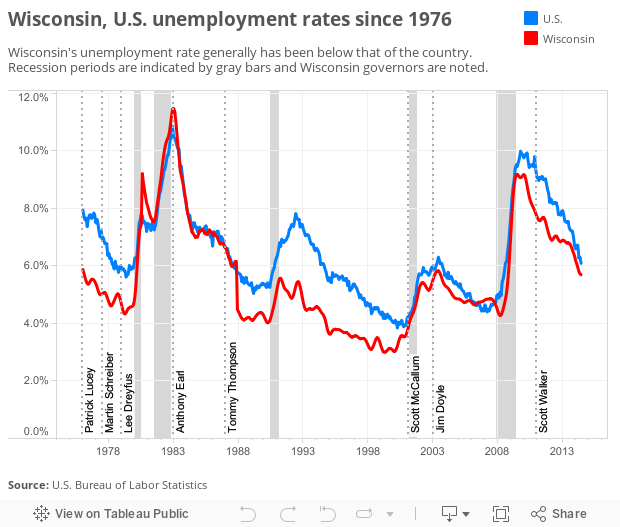
Democratic Governor Jim Doyle's Great Recession: Walker's reelection bid is a smoke and mirrors extravaganza. Walker continues to blame the Great Recession on Gov. Doyle and the Democrats, blaming them for the massive job losses and high unemployment rate in the state, which by the way, was still lower than the national average. Walker repeats this so often the media has given up correcting him:


Even Walker's tweeted graph shows the dramatically lower unemployment rate in Wisconsin when he took office vs the national rate:


Here's an interactive graphic showing the exact numbers...:


Participation Rate BS: One of Walker's biggest bragging points is the states lower labor participation rate vs the national rate. But wait, our participation rate has always been lower, a trending mirror image of the slightly higher national rate...so...Walker is simply and unabashedly misleading voters, and taking credit for not really doing anything:


Walker's Rising Poverty: And who could forget this not so shocking rise in the poverty rate under Walker:
WSJ: Despite a new report showing Wisconsin has the fastest-shrinking middle class in the U.S., the Gov. Scott Walker administration says the state is headed in the right direction.

March 24, 2015: Wisconsin ranks worst among the 50 states in terms of a shrinking middle class, with real median household incomes here falling 14.7 percent since 2000, according to a new report. The Pew Charitable Trust report showed Wisconsin with the largest decline in the percentage of families considered "middle class."

The median household income in Wisconsin was $60,344 in 2000 but now stands at just $51,467 after adjusting for inflation. That’s a dip of 14.7 percent. Nationally, median household incomes fell from $55,987 to $51,939 over the period, a decline of 7.2 percent.
Walker says No Hike in Minimum Wage: Walker has the luxury those stuck in the cycle of poverty don't, and that is to dream of better days:
The Wisconsin Department of Workforce Development, and issued a statement saying: "Governor Walker wants jobs in Wisconsin that pay two or three times the minimum wage.

Scott Walker: "The left claims that they're for American workers and they've just got really lame ideas — things like the minimum wage. Instead of focusing on that, we need to talk about how we get people ... the careers that pay far more than the minimum wage."
What Walker doesn't want you know? Even business CEO's think the minimum wage should be raised, and that's from right wing word smith Frank Luntz:
The survey of 1,000 business executives across the country was conducted by LuntzGlobal, the firm run by Republican pollster Frank Luntz, and obtained by a liberal watchdog group called the Center for Media and Democracy. (The slide deck is here, and the full questionnaire is here.) Among the most interesting findings: 80 percent of respondents said they supported raising their state's minimum wage, while only eight percent opposed it. "That’s where it’s undeniable that they support the increase,” Luntz told state chamber executives in a webinar describing the results.
Note: I just did a quick search for most of the above information. So why isn't the Wisconsin Democratic Party putting even more of this stuff together and arming possible candidates with the truth about Walker's record...I have no idea.

Saturday, May 21, 2016

Walker's Wisconsin takes Private Sector Jobs Hit.

You'd think after Act 10, right-to-work, zero taxes for agriculture and manufacturing, and about $50 in average middle class tax cuts, businesses would be rushing into Wisconsin on the say-so of Chief Executive magazine’s annual “Best State for Business” survey of CEOs. Guess not...
Wisconsin's three-month run of job growth was halted in April by the largest one-month loss in jobs in nearly seven years. The state lost 11,500 private-sector jobs in April, 0.5 percent of the workforce, according to preliminary, seasonally adjusted estimates by the Bureau of Labor Statistics.

If the figures stand up to revisions, it will be the state's biggest monthly jobs drop since July 2009, during the Great RecessionIn April, Wisconsin lost 4,200 manufacturing jobs, 0.9 percent of the total for the state's largest job sector, to return to a flat level of growth since last October.

Scott Walker, like all the other GOP governors, don't mind being willing dupes of big business CEO's who keep making promises they don't intend to keep. And they're laughing all the way to the bank. Every year Chief Executive magazine praises Walker's Wisconsin, and every year nothing happens.

And it's crazy too, because Walker continues to focus on manufacturing, instead of diversifying the state economic options.

Note: Economist John Koskinen just gave us a little insight into one of Walker's biggest bragging points, that the labor participation rate is higher here than it is for the rest of the country. Hint: labor is leaving the state... 
One of the things that contributes to this increase is that Wisconsin has a fairly low population growth which gives us stronger per capita GDP growth than the rest of the country, “Since 2010, that’s what’s been happening,” Koskinen said.

Friday, May 20, 2016

CEO dupe Scott Walker can't stop the job losses.

Over and over again, job layoff announcements have been announced and no one seems to be around to add them up or point them out. Is it another Scott Walker failure? His big selling point was making the state a great place to do business. But nothing has change, and the bloodletting continues.

I tried to do search of all the recent stories, but time has already swept most of those stories into a forgotten archive somewhere.

 So here's the latest:
Old National Bancorp has notified state officials it plans to eliminate 140 full-time jobs, almost all of them in Madison ... Most of the positions will terminate in September.

Caterpillar Inc. said it is moving engineering and technology jobs from its mining equipment division in South Milwaukee to Tucson, Ariz. … South Milwaukee Mayor Erik Brooks said the company told him 10 to 15 jobs from his city will be moved to Arizona this year and approximately 200 jobs could be moved over the next five to seven years … the bulk of the transfers will take place in 2018.
 Caterpillar has laid off hundreds of employees in the Milwaukee area and now employs about 240 at its manufacturing plant in South Milwaukee, down from 800 a few years ago.
As always, Arizona Republicans found a way to help the supposed free market work its magic…
Some have speculated that Arizona offered Caterpillar more than $50 million in incentives in exchange for the jobs. Caterpillar didn't reach out to Wisconsin or Milwaukee officials for assistance in keeping the jobs here.
Yes, CEO's are saying the business climate great, but they're not lifting a finger to help. Even after Scott Walker’s gift of lax environmental regulations for mining, Caterpillar is still leaving.

Sunday, March 27, 2016

Walker admits defeat on Job Creation, now attacks the number of help wanted ads.

I'm off to Easter with the family, but there's something I'm looking into that lies at the very heart of Scott Walker's desire to fill the jobs already open, and not create new ones.

Word salad Walker offered up this down-the-rabbit-hole logic:
Walker: "One of my top priorities has shifted from job creation to filling jobs, which really in turn becomes a form of economic development going forward because for a lot of employers in this state if they don’t have confidence they can fill vacant positions now, that becomes a barrier to adding more jobs in the future."
Will we be able to survive 3 more years of this Bizarro World approach to managing the state?

What is the historical average of the open jobs market? It seems likely that number would be pretty consistent. So is it ridiculous to change what might be unchangeable, all those help wanted ads that persist no matter what happens, because of the ebb and flow of the marketplace (hint: Jake?)?

One thing I do know, Walker is now marketing a new product for a third term, smaller in size, gluten free, but at a more expensive price; last in the Midwest in almost all jobs and business creation categories.


Friday, January 8, 2016

Walker's corporate welfare to biggest donors ignores the real job creators, sole proprietors and small businesses.

The Republicans have big problem; owing their political careers to big monied interests.

Besides consumer demand, the real job creators can't afford Scott Walker's or the GOP's attention, like sole proprietors or very small business with only a few employees.

And that's why Scott Walker and his band of plundering Republican pirates are last in business startups and a disaster at job creation. It's all about politics and ideology:
Economist Joe Stiglitz points out "a deficiency of aggregate demand, brought on by a combination of growing inequality and a mindless wave of fiscal austerity."

He says the only cure is an increase in aggregate demand, far-reaching redistribution of income and deep reform of our financial system. The obstacles to this cure, he writes, "are not rooted in economics, but in politics and ideology."
Despite Democratic efforts to focus on small business startups, no one ever took them seriously.

But a new study backs up their efforts, and highlights how everything the GOP and Walker's WEDC have done in the last 5 years is wrong. Cap Times:
UW study: Startups driving job growth, but policies favor big business: A couple of University of Wisconsin-Extension economics researchers have a message for the state: It’s the startups, stupid.

Tessa Conroy and Steven Deller recently completed a study showing that Wisconsin job growth is fueled by newer, smaller businesses. But the report says state policies tend to boost larger, more established businesses. “Given the importance of new startups to job creation, the relatively low ranking for Wisconsin helps us better understand why Wisconsin’s recovery from the Great Recession has been one of the slowest in the U.S.,” the authors write.

That might help explain why job growth in Wisconsin lags ... 7.6 percent for the state versus 11.2 percent for the U.S. over the past five years.

In Wisconsin, policymakers often blame dismal job numbers on slowdowns in the manufacturing sector or the decline of the paper industry. Their findings showed that newer, smaller businesses rule. And without new startups, according to the study, Wisconsin would be “experiencing a significant job loss” ... nearly 50 percent of job creation in Wisconsin is done by businesses between 0 and 5 years old, about half of them from businesses less than a year old, and which have few employees.
To the chagrin of Republicans, these small businesses can't afford to stuff their campaign coffers.
And the performance by Wisconsin startups is fairly lackluster compared to the rest of the country. For jobs created from newly birthed startups in 2012 — the most recent year for which data was available — Wisconsin ranked 47th among the lower 48 states.

“In Wisconsin, and across the nation, new business startups are key to job creation ... Equally important is the survival rate of those new startups. The question is: Can Wisconsin craft policies that encourage new business startups and support them in the key first three to five years of operation?”

There are jobs, and there are potential jobs. The latter often come in the form of the state’s non-employer businesses, which have increased in number by 25 percent since 2000, accounting for 71 percent of total businesses in 2013. These businesses, the smallest businesses in the state, are concentrated in non-farm agriculture, fishing, hunting, real estate, the arts and entertainment. They don't have employees, but they generate economic activity, and if they grow can lead to hiring employees. But again, according to the report, Wisconsin lags both the U.S. and neighboring states in the creation of non-employer businesses.
And from all indication, Madison is strong on startups:
In the Madison area ... jobs created from new startups increased from 10 percent of the state total to 12 percent from 1977 to 2013. “This growing importance of ‘entrepreneurship’ is something that economists have known about for years, but policies still tend to favor larger established (older) businesses.”

He points to Wisconsin Economic Development Corp. policies that favor larger manufacturing firms over smaller startups ... a WEDC webpage touting the agency's successes ... heavy on large corporations or multinationals like papermaker Pratt Industries, global manufacturer Gardner Denver and Ireland-based Kerry Ingredients. WEDC also focuses on luring existing businesses to the state, which in reality rarely happens. “Very few companies really move around that much,” he said. “The vast majority of startups are located in the community that the owner lives in.”

So why doesn’t the state put its money where the jobs are? Deller, who’s not been shy about criticizing state economic policies in the past, has a theory. “In today’s increasing pressure to raise money, politicians are drawn toward those larger, established firms because they have the resources to make significant contributions. Smaller startup firms are not in a position to be proactive in terms of significant donations.”

Add to that the fact that startups don’t lobby. “Politicians are looking to be associated for business activity that draws media attention.”
So what can be done? Well, you can bet Scott Walker won't learn from any of this:
To counter these factors, Conroy and Deller recommend a multi-pronged approach to encouraging new business ventures, including educational opportunities from the state universities and technical colleges to local efforts by chambers of commerce and business associations to match entrepreneurs with workshops and mentors. They also suggest boosting financial support on the state level through loan guarantees and other programs.

“Support for new business owners, even those that do not yet have employees, could lead to higher gross and net job creation.

Friday, December 18, 2015

Walker's Wisconsin 37th in Private Sector Job Growth. June to June Slowest since Great Recession ended.

Ask a “Stand with Walker” supporter about how well the governor is doing, and you’ll get rave reviews. Sadly, the reason has less to do with Walker’s jobs and business success than it has to do with their satisfaction level of just being in power.

The latest bad news about job growth will again get the Walker treatment; distract supporters by talking about the low unemployment rate, which by itself, is another manipulated area of failure; Walker made it more difficult to get and/or stay on unemployment, and the exodus of labor leaving the state for higher wage jobs elsewhere.

And yet the consequences of simply keeping Republican politicians in power, no matter how bad it gets, continues to mount; slow job growth, increased utility rates, a eventual dramatic hike in tuition, declining wages, and local referendums to increase taxes for schools and road funding. 

Many of us knew we were in trouble when conservative voters we’re high-fiving Walker’s $1 cut in property taxes. Pathetic?

Wisconsin is slipping nationally again…but so what right:
WPR: The latest "gold standard" job numbers from the U.S. Bureau of Labor Statistics show that Wisconsin ranked 37th in the nation in private-sector job growth from June 2014 to June 2015.

Wisconsin also ranked eighth out of 10 Midwest states. Among states that share a border with Wisconsin, only Iowa added jobs at a slower rate.
And while Walker bashes Obama for the nations higher unemployed non-participation rate, it’s just another distraction: 
Overall, Wisconsin added 30,759 private-sector jobs, a growth rate of nearly 1.3 percent. By comparison, the national economy added jobs at a rate of 2.3 percent.

This June-to-June period was one of the slowest for Wisconsin since the Great Recession ended.
Here are the numbers from a June report:

During the four years of Walker's first term, Wisconsin ranked last among its peer states in the Midwest, a region that shares a common economy of factory cities and farm towns. Wisconsin's 35th job-creation ranking trailed Michigan (10th), Indiana (18th), Minnesota (23rd), Ohio (25th), Iowa (31st) and Illinois (33rd).
It should also be noted how big money from big business, especially during Walker's presidential fund raising, had the attention of Republican politicians, when they should have been focusing in on smaller business startups:
Research Finds Wisconsin Is Home To Fewest Startups In The Nation: Ask WMC Leader Jim Morgan why Wisconsin comes in dead last in the race to attract new entrepreneurs, and he'll tell you it all comes down to perception.
The Walker war on Milwaukee has had an especially negative impact on startup businesses, the real source of job creation:
Wisconsin looks like a lagging state in technology entrepreneurship, said Greg Meier, managing director of WERCBench Labs, an accelerator for Milwaukee-area tech start-ups. The issue is particularly acute in and around Milwaukee, which is in a "deficit situation" in terms of technology innovators, Meier said. "The rest of the world isn't waiting for us to catch up," Meier said.

Start-ups create more jobs than established entities, he said. "We reap the seeds we sow at the end of the day," Meier said, "but we sow very few seeds in terms of entrepreneurship."

Friday, November 6, 2015

Walker: A Deer in Reality's Headlights!

Remember this gem from early on in Scott Walker's first term as governor, still posted at Office of the Governor Scott Walker:
"In 2010, a mere 10 percent of employers said our state was headed in the right direction; in 2014, 96 percent said Wisconsin is headed in the right direction. Creating jobs is about more than just a campaign promise." (hey it was a promise, not just a goal!)
Can you say "sucker?" Of course they loved the idea of tax cuts, go figure.

But business leaders, economists and Democrats disagreed with Scott Walker's plan to reduce corporate taxes in the state, saying that was not a major deciding factor for businesses contemplating staying or coming to the state. Lifestyle, services, transportation, and an educated workforce topped their lists.

But Walker stuck with his purely ideological supply side plan, and it's now collapsing around him, with the announcements from Oscar Mayer and S.C. Johnson. Sadly there is little or no blowback from conservative voters. In 2017, Oscar Mayer would have gotten this Walker gift, which as we can see now, didn't influence Oscar Mayer's decision one bit:
The Manufacturers and Agricultural Production Tax Credit will reduce corporate tax liability for manufacturers to 0.4 percent from 7.9 percent by 2017. 
And Walker's only bragging point about the low unemployment numbers got really old a year ago, so let it go for gods sake. The graph below, from Urban Milwaukee, points out why the low unemployment rate may be partly due to losing workers to other states:


With no business sense or curiosity to ask Oscar Mayer about the merger and what it might mean for Wisconsin...:
Wisconsin's flagship economic development agency did not contact Kraft Heinz after the company's landmark merger, and it was not among the states that offered economic incentives to prevent layoffs at Kraft Heinz manufacturing plants.

Madison Mayor Paul Soglin said from what he could tell WEDC had not contacted the firm since a shift in ownership this year. "If WEDC failed to contact Oscar Mayer in the critical months of July and August of this summer, why would anyone think there is anything productive to be gotten out of WEDC?"
In another instance of Wisconsin media giving Walker a pass on accountability, Walker’s deceptive lie about WEDC contacting Kraft Heinz but never saying when, only got a mention. WPR:
Gov. Scott Walker told reporters Thursday that WEDC had made contact with Kraft Heinz, and that the company turned down help from the state.
"The bottom line is they've had contact with the WEDC in the past. We've provided assistance. They said they didn't need that assistance."
As it turns out, that contact happened a full two years before Kraft Foods Group and Heinz finalized a multi-billion dollar merger to become one of the world's largest food companies.
And no one in the press felt played or pissed off?

Here's local news coverage documenting Walker's excuses and failed policies:


Walker's not at fault again, while former Gov. Doyle is still blamed for Great Recession's job losses: Walker was quick to blame known liberal investor Warren Buffett, and not himself. Fox 6:
Scott Walker: "You'll have to ask people like Mr. Buffett and others whose companies engineered this decision. It has nothing to do with Wisconsin, it has everything to do with a corporate decision that was made by the merger of those two companies. It's not something where they've even made contact with us.”

S.C. Johnson announced plans to transition 175 jobs to the Windy City within the next two years:

Walker: "The bottom line is different there. They've got significant investment in the state. In this case, it was specific to marketing positions. They've had a hard time attracting those because they attract them globally, not just here in the Midwest.”
Walker's decision to revive a fading manufacturing base in the state at the expense of every other emerging industry, narrowed Wisconsin's options for recovery. Now Walker is using that as an excuse to justify job losses? 

Adding insult to injury, this was the headline today:

Burst of hiring: US employers added 271,000 jobs in October


Illinois Slaps Back: Wouldn't you know it, Chicago Business magazine provided a brief Walker history highlighting his vindictive efforts to hurt other states:
You may recall a news conference a couple of years ago at which Wisconsin Gov. Scott Walker presented a $500,000 check to an Illinois trade show display company that was moving north across the border, declaring "There's a better place here."

Or the time the governor urged Illinois firms to "escape to Wisconsin."

Or the similar $500,000 ad campaign aimed at employers here and in the Minneapolis/St. Paul area.Well, governor, let me introduce you to Oscar Mayer, which yesterday announced it's laying off 2,600 people all over the country—including in Wisconsin—but moving 250 well-paying jobs and its headquarters from Madison to downtown Chicago.

Not to mention consumer products giant SC Johnson, which announced today that it's bringing 175 jobs to downtown Chicago from its headquarters in Racine, Wis.

Touche, Gov. Walker. Perhaps this week's news will underline the point: Raiding the neighbor's pantry doesn't do much to enrich the neighborhood.
Here is a list of some of the jobs lost in the past couple of months. jsonline:
Dairy equipment manufacturer BouMatic LLC: Cut 59 jobs Tuesday as it closes metal fabrication, welding, machining and assembly departments at its Madison factory.

Joy Global Inc.: This week said it was closing its mining equipment facility resulting in the loss of 56 jobs. In October, the company said it was laying off 113 people at the National Avenue plant.

Harley-Davidson Inc.: Said in October it was cutting about 250 salaried jobs by the end of the year, across the company.

We Energies' parent company said in October it would cut jobs in Milwaukee and Green Bay.

General Electric announced in September that it would stop making engines in Waukesha and cut 350 jobs.

Caterpillar Inc., a heavy-equipment manufacturer in South Milwaukee that builds some the word's largest mining machines, says in September it's cutting about 10,000 jobs worldwide in the next four years.

Johnson Controls announced in August that the company plans to cut up to 197 jobs at its newest office in the Milwaukee area, in West Allis.
More bad news:
According to the Department of Workforce Development, 9,341 plant workers across the state have lost their jobs this year in mass layoffs between the beginning of the year and mid-October. That compares with 6,186 layoffs all of last year.
Trickle Down Disaster a Surprise? That's what the lobbyists at WMC are saying. BizJournal:
Kurt Bauer, president and CEO of Wisconsin Manufacturers & Commerce, said he was also surprised by the Oscar Mayer move. "I think we’ve done an awful lot recently to make Wisconsin a good place for food and beverage manufacturing … Bauer cited recent legislative changes like the Manufacturers and Agricultural Production Tax Credit, which will reduce corporate tax liability for manufacturers to 0.4 percent from 7.9 percent by 2017. "I think Wisconsin is as competitive as anybody in the upper Midwest." 

That said, the increase in mass layoffs so far this year compared with last year is disconcerting to Bauer. "But just look at the economic indicators in the last few weeks. It’s been mostly downward, with GDP in the last quarter only up 1.5 percent in the U.S."
I found this in May of 2009, and have posted it many times.